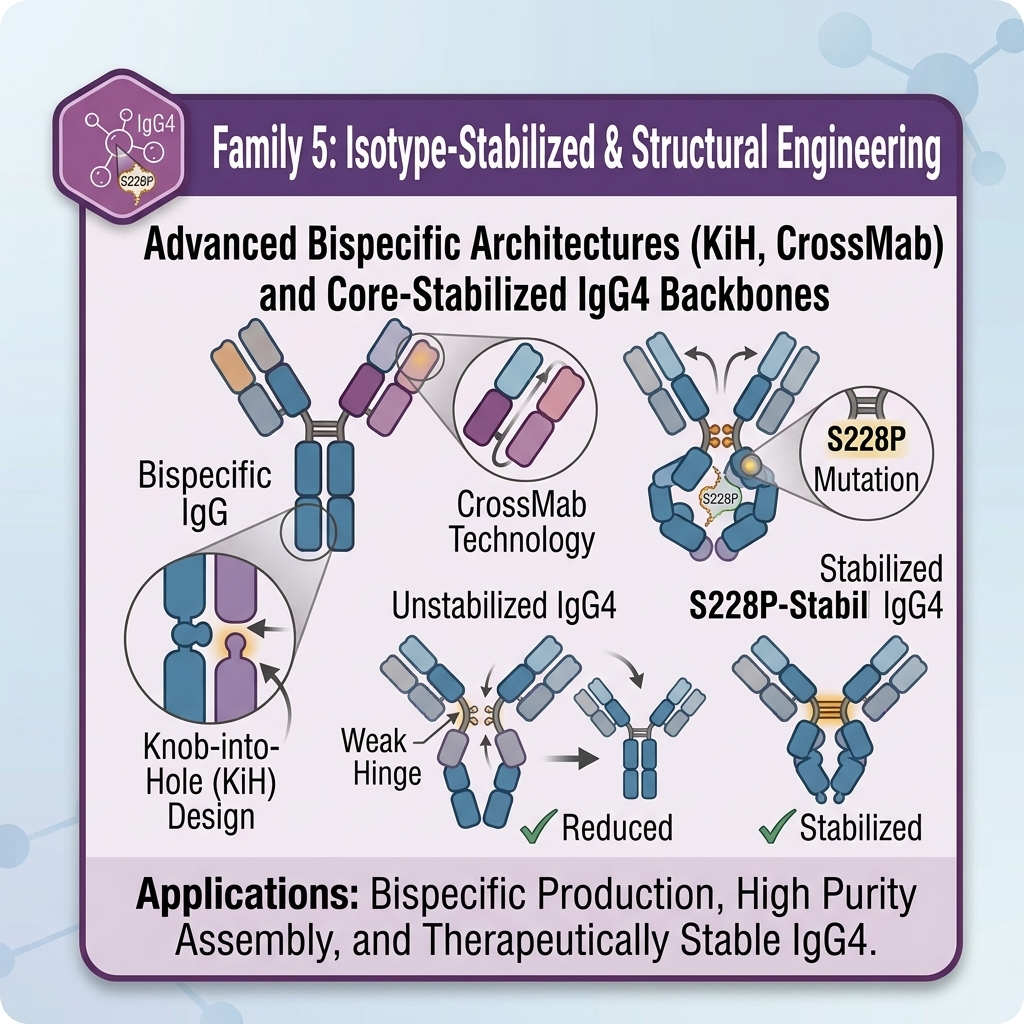
Plasmid Name
pHC-IgG1 (M252Y/S254T/ T256E + H433K/M434F)
Mutation Set
YTE (M252Y/S254T/T256E) + KF (H433K/M434F)
Selection Marker
Ampicillin
Promoter
CMV
Fc Engineering Overview
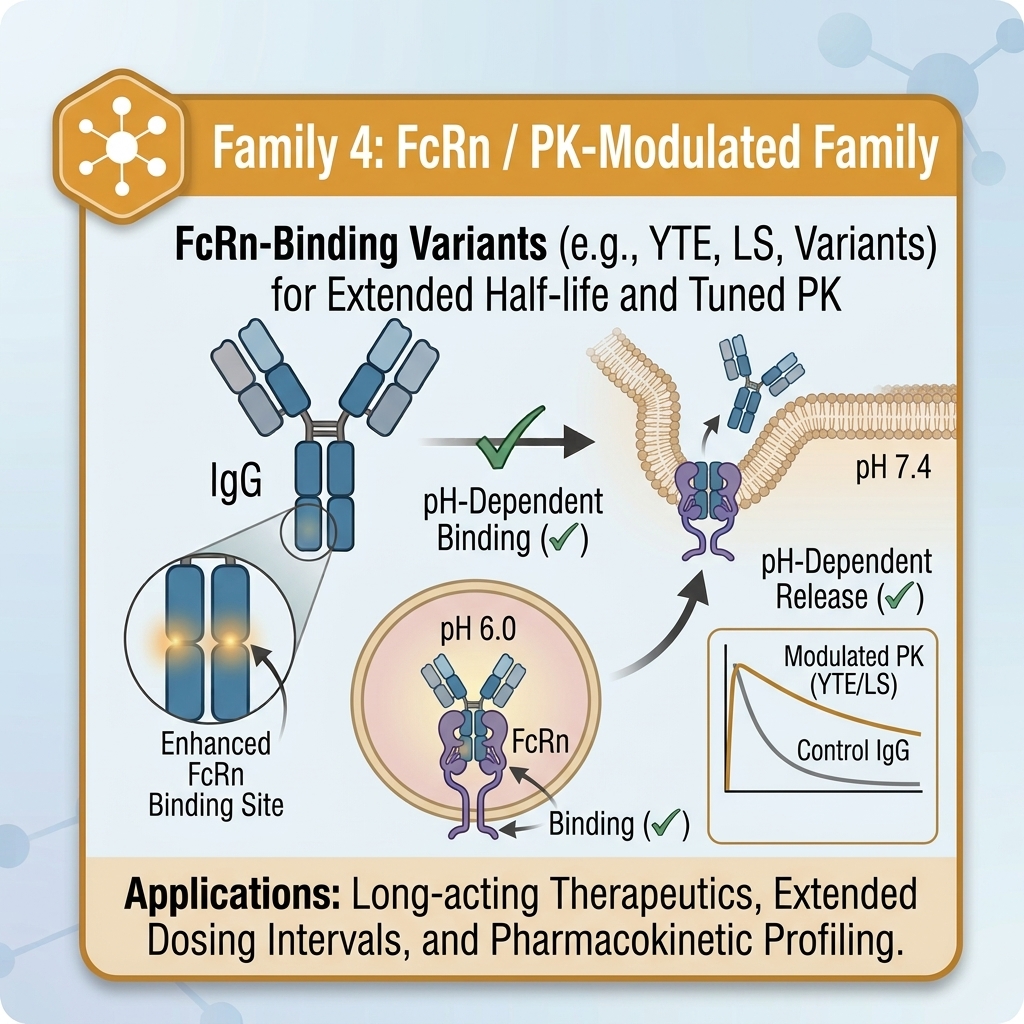
The Human IgG1 (M252Y/S254T/T256E + H433K/M434F) — YTE + KF Fc Variant integrates two powerful, synergistic FcRn-enhancing modules to create an ultra-long-acting Fc. By combining the YTE module in the CH2 domain with the KF module in the CH3 domain, this variant achieves very high FcRn binding and an ultra-extended serum half-life (4–8× depending on species) alongside reduced effector function.
Functional Profile
| Property | Effect |
|---|---|
| FcγR binding | Reduced ↓ |
| ADCC | Reduced ↓ |
| CDC | Reduced ↓ |
| FcRn binding | Very High ↑↑↑ |
| Serum half-life | Ultraextended ↑↑↑ |
| PK profile | Ultralong-acting |
Mechanism of Action
The YTE + KF composite Fc integrates two powerful FcRn-enhancing modules:
- YTE (CH2 domain): Increases FcRn affinity at acidic pH, reduces FcγR and C1q interactions, and extends half-life 2–4× on its own.
- KF (CH3 domain): H433K and M434F strengthen FcRn binding at the CH3 interface and further increase recycling efficiency.
Together, these modules produce synergistic FcRn enhancement, resulting in one of the longest-acting Fc variants available.
Phenotypic Effects
- Dramatically increased FcRn binding.
- Ultra-long serum half-life (4–8× depending on species).
- Strong reduction in ADCC and CDC.
- Minimal FcγR engagement.
- Maintains structural integrity and antigen binding.
- Ideal for long-acting biologics requiring infrequent dosing.
Applications
- Ultra-long-acting therapeutic antibodies.
- FcRn mechanistic studies.
- PK/PD optimization for extended-duration biologics.
- Antibodies requiring minimal effector function.
- Preclinical development of next-generation long-acting therapeutics.
Sequence Map & Feature Annotation
Insert Architecture: VH – CH1 – hinge – CH2(M252Y/S254T/T256E) – CH3(H433K/M434F)
- VH: Variable heavy domain
- CH1: Constant heavy 1
- Hinge: Native IgG1 hinge
- CH2(M252Y/S254T/T256E): YTE FcRn-enhancing mutations
- CH3(H433K/M434F): KF FcRn-enhancing mutations
Product Note: The YTE + KF Fc variant represents one of the most advanced FcRn-enhancing engineering strategies available. It is ideal for biologics requiring ultra-long half-life, reduced dosing frequency, and minimal effector function.
Comparison within Fusion BioLabs FcRn / PK-Modulated Fc Variant Family
| Variant | Mechanism | Strength (PK Extension) | Primary Application & Notes |
|---|---|---|---|
| human IgG1 (WT) (Wild-Type) |
Native FcRn binding | ★★☆☆☆ | Baseline Control. Standard physiological baseline (∼21-day half-life in humans). |
| human IgG1 (N434A) N434A |
Single-point FcRn-enhanced | ★★★☆☆ | Single-point mutation providing a moderate 1.5–2× PK boost with low immunogenicity risk and easy manufacturing integration. |
| human IgG1 (LA) M428L / N434A |
FcRn-enhanced | ★★★★☆ | Strong PK Extension. Dual mutation combining M428L and N434A; enhances acidic FcRn binding with minimal neutral binding. |
| human IgG1 (LS) M428L / N434S |
FcRn-enhanced | ★★★★★ | Very Strong PK Extension. Extends human serum half-life up to 3–5× (>70–90 days; e.g., tixagevimab/ cilgavimab). |
| human IgG1 (YTE) M252Y / S254T / T256E |
FcRn-enhanced | ★★★★★ | Benchmark PK Extension. Industry-standard benchmark delivering ∼3–4× PK boost in humans (e.g., nirsevimab / Beyfortus®). |
| human IgG1 (QL) T250Q / M428L |
FcRn-enhanced | ★★★★☆ | Moderate-to-Strong PK Extension. Increases acidic FcRn affinity with favorable intellectual property freedom to operate. |
| human IgG1 (YTE + KF) M252Y/S254T/T256E + H433K/N434F |
Hyper-FcRn-enhanced / FcRn Blocker | ★★★★★ | This Product. FcRn Antagonist / Autoimmune Control. Binds tightly across pH 6.0 and 7.4 to block FcRn recycling and clear endogenous IgGs. |
| human IgG1 (V308P) V308P |
Controlled/Accelerated Clearance | ★★☆☆☆ | Tunable Fast-Clearance Variant. Modulates FcRn dissociation kinetics to yield accelerated clearance (2–5-day half-life); ideal for ADCs and immuno-PET imaging to limit non-target toxicity. |
| human IgG1 (I253A) I253A |
FcRn-null / Abrogated | ★☆☆☆☆ | Ultra-Fast Clearance Control. Complete knockout of the core FcRn binding triad; rapidly cleared within hours. |
Storage & Handling
- Store plasmid at −20°C.
- Avoid repeated freeze–thaw cycles.
- Use sterile technique when handling.
- Suitable for transient or stable mammalian expression.
References
- Vaccaro C, Zhou J, Ober RJ, Ward ES. Engineering the Fc region of immunoglobulin G to modulate in vivo antibody levels. Nat Biotechnol. 2005;23(10):1283-1288.
- Grevys A, Bern M, Foss S, Bratlie DB, Moen A, Gunnarsen KS, Aase A, Michaelsen TE, Sandlie I, Andersen JT. Fc Engineering of human IgG1 for altered binding to the neonatal Fc receptor affects Fc effector functions. J Immunol. 2015;194(11):5497-508.