Fc Engineering Overview
The Human IgG1 (I253A) — FcRn-Reduced Fc Variant contains a single amino acid substitution (I253A) in the CH2 domain designed to disrupt a key hydrophobic contact required for FcRn engagement at acidic pH. By reducing FcRn binding and impairing recycling, this variant significantly shortens serum half-life and accelerates systemic antibody clearance while fully preserving wild-type FcγR binding and effector functions (ADCC/CDC).
Functional Profile
| Property | Effect |
|---|---|
| FcγR binding | Normal |
| ADCC | Normal |
| CDC | Normal |
| FcRn binding | Reduced ↓ |
| Serum half-life | Shortened ↓ |
| PK profile | Faster clearance |
Mechanism of Action
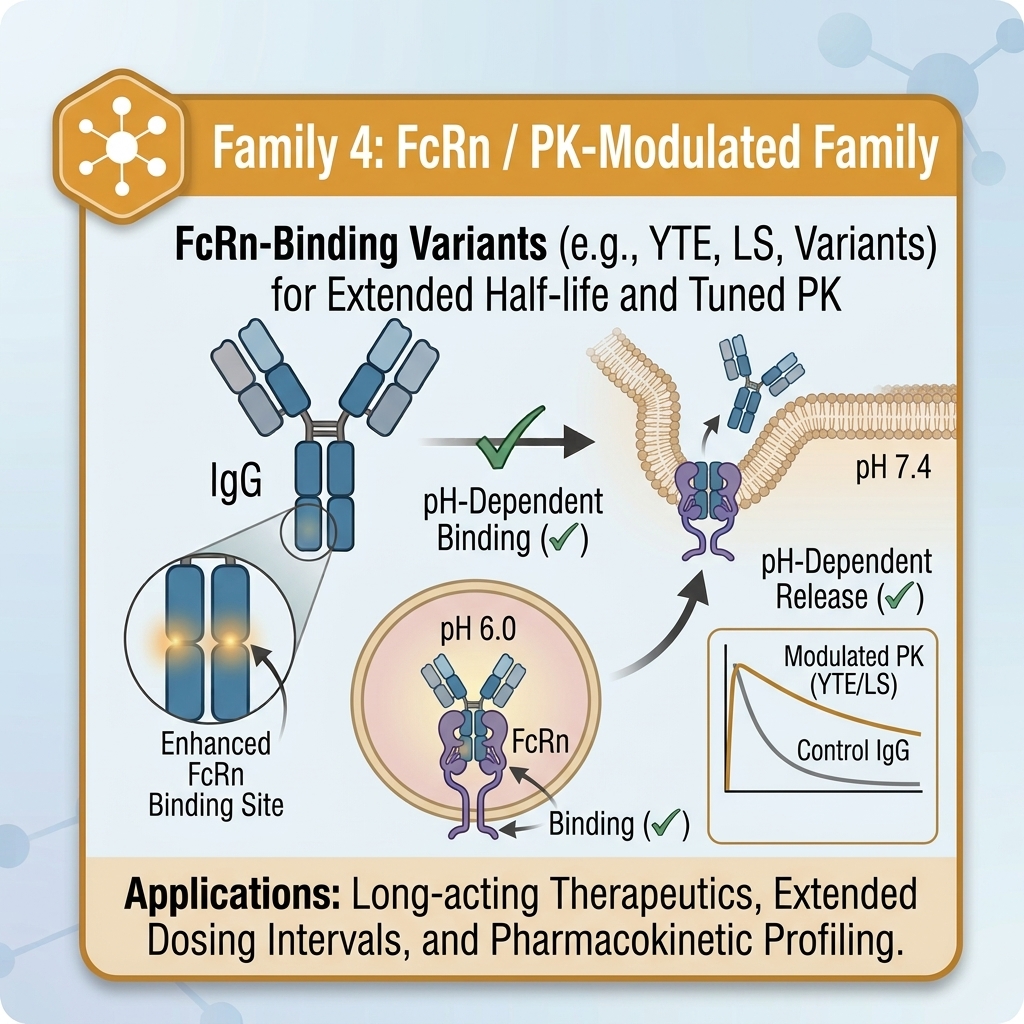
The I253A mutation replaces isoleucine with alanine, disrupting a critical hydrophobic residue in the CH2 domain that forms part of the core FcRn binding triad. Loss of this contact point impairs pH-dependent FcRn engagement, preventing efficient salvage and recycling through the endosomal pathway. This drives rapid target and systemic clearance while maintaining normal IgG1 effector function profile and structural stability.
Phenotypic Effects
- Reduced FcRn binding affinity.
- Shortened serum half-life and accelerated clearance.
- Maintains normal ADCC and CDC effector functions.
- Preserves overall antibody structural integrity.
- Ideal for applications requiring rapid clearance or tightly controlled exposure.
Applications
- Diagnostic imaging agents requiring low background noise.
- Mechanistic studies evaluating FcRn-mediated recycling biology.
- PK/PD tuning for short-acting or payload-carrying therapeutics.
- Preclinical evaluation of fast-clearing antibody formats where prolonged exposure causes toxicity.
Sequence Map & Feature Annotation
Insert Architecture: VH – CH1 – hinge – CH2(I253A) – CH3
- VH: Variable heavy domain
- CH1: Constant heavy 1
- Hinge: Native IgG1 hinge
- CH2(I253A): FcRn-reducing mutation
- CH3: Constant heavy 3
Comparison within Fusion BioLabs FcRn / PK-Modulated Fc Variant Family
| Variant | Mechanism | Strength (PK Extension) | Primary Application & Notes |
|---|---|---|---|
| human IgG1 (WT) (Wild-Type) |
Native FcRn binding | ★★☆☆☆ | Baseline Control. Standard physiological baseline (∼21-day half-life in humans). |
| human IgG1 (N434A) N434A |
Single-point FcRn-enhanced | ★★★☆☆ | Single-point mutation providing a moderate 1.5–2× PK boost with low immunogenicity risk and easy manufacturing integration. |
| human IgG1 (LA) M428L / N434A |
FcRn-enhanced | ★★★★☆ | Strong PK Extension. Dual mutation combining M428L and N434A; enhances acidic FcRn binding with minimal neutral binding. |
| human IgG1 (LS) M428L / N434S |
FcRn-enhanced | ★★★★★ | Very Strong PK Extension. Extends human serum half-life up to 3–5× (>70–90 days; e.g., tixagevimab/ cilgavimab). |
| human IgG1 (YTE) M252Y / S254T / T256E |
FcRn-enhanced | ★★★★★ | Benchmark PK Extension. Industry-standard benchmark delivering ∼3–4× PK boost in humans (e.g., nirsevimab / Beyfortus®). |
| human IgG1 (QL) T250Q / M428L |
FcRn-enhanced | ★★★★☆ | Moderate-to-Strong PK Extension. Increases acidic FcRn affinity with favorable intellectual property freedom to operate. |
| human IgG1 (YTE + KF) M252Y/S254T/T256E + H433K/N434F |
Hyper-FcRn-enhanced / FcRn Blocker | ★★★★★ | FcRn Antagonist / Autoimmune Control. Binds tightly across pH 6.0 and 7.4 to block FcRn recycling and clear endogenous IgGs. |
| human IgG1 (V308P) V308P |
Controlled/Accelerated Clearance | ★★☆☆☆ | Tunable Fast-Clearance Variant. Modulates FcRn dissociation kinetics to yield accelerated clearance (2–5-day half-life); ideal for ADCs and immuno-PET imaging to limit non-target toxicity. |
| human IgG1 (I253A) I253A |
FcRn-null / Abrogated | ★☆☆☆☆ | This Product. Ultra-Fast Clearance Control. Complete knockout of the core FcRn binding triad; rapidly cleared within hours. |
Storage & Handling
- Store plasmid at −20°C.
- Avoid repeated freeze–thaw cycles.
- Use sterile technique when handling.
- Suitable for transient or stable mammalian expression.
References
- Kim JK, Tsen MF, Ghetie V, Ward ES. Localization of the site of the murine IgG1 molecule that is involved in binding to the murine intestinal Fc receptor. Eur J Immunol. 1994;24(10):2429-2434.
- Kim JK, Firan M, Radu CG, Kim CH, Ghetie V, Ward ES. Mapping the site on human IgG for binding of the MHC class I-related receptor, FcRn. Eur J Immunol. 1999;29(9):2819-2825.
- Martin WL, West AP Jr, Gan L, Bjorkman PJ. Crystal structure at 2.8 A of an FcRn/heterodimeric Fc complex: mechanism of pH-dependent binding. Mol Cell. 2001;7(4):867-877.