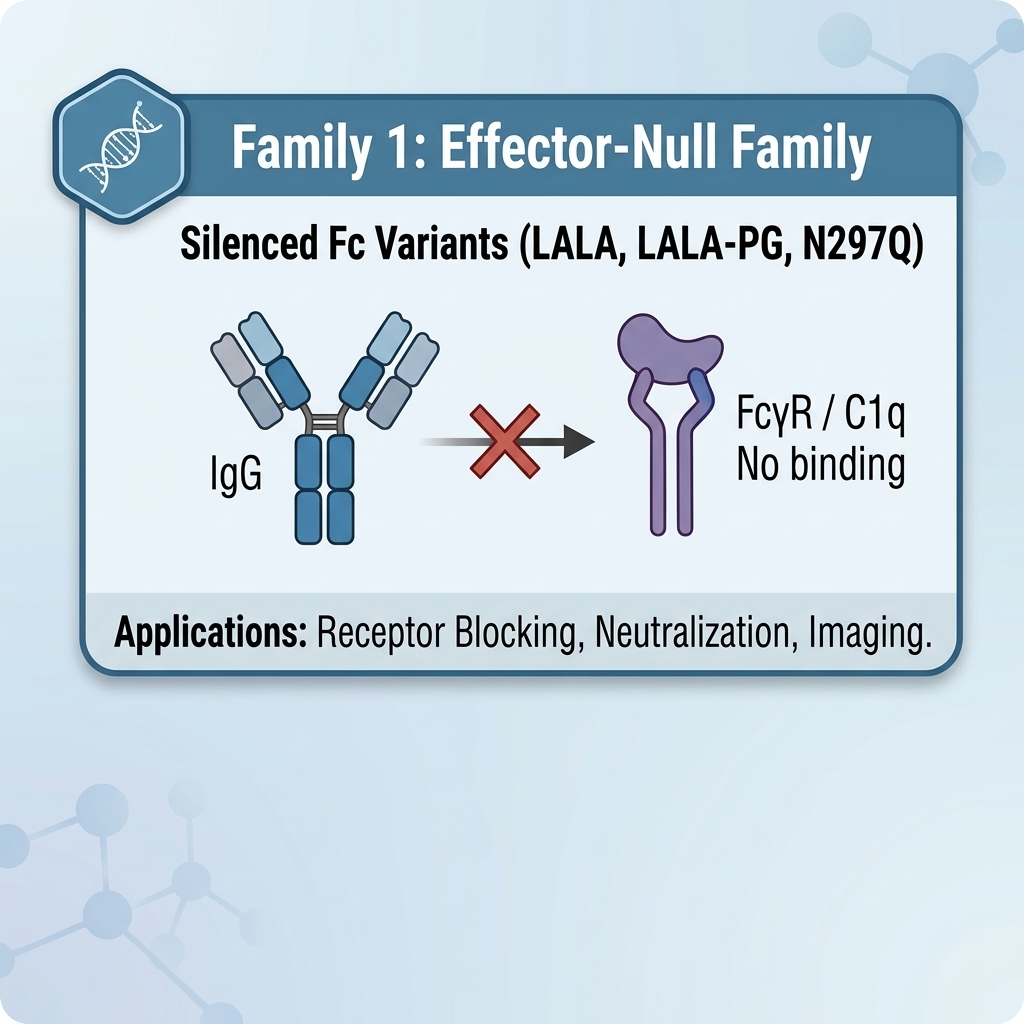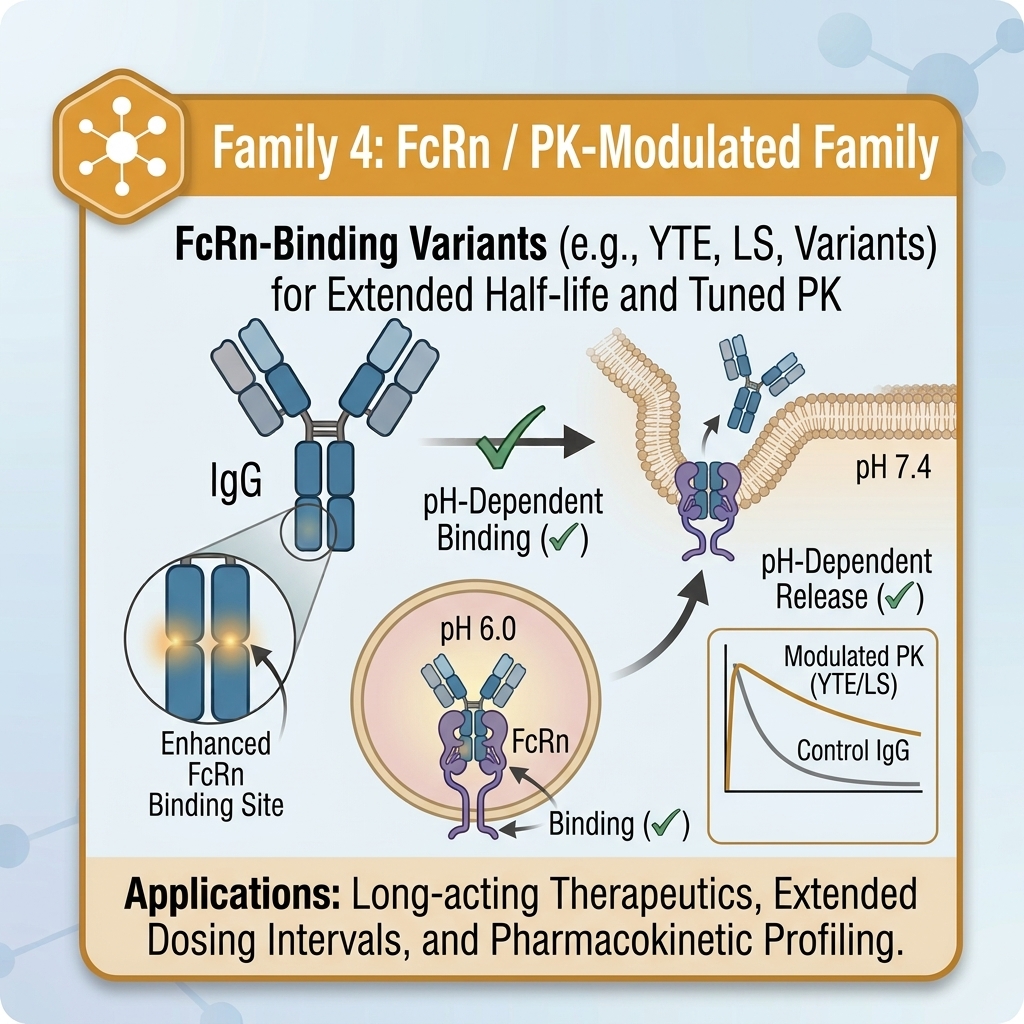
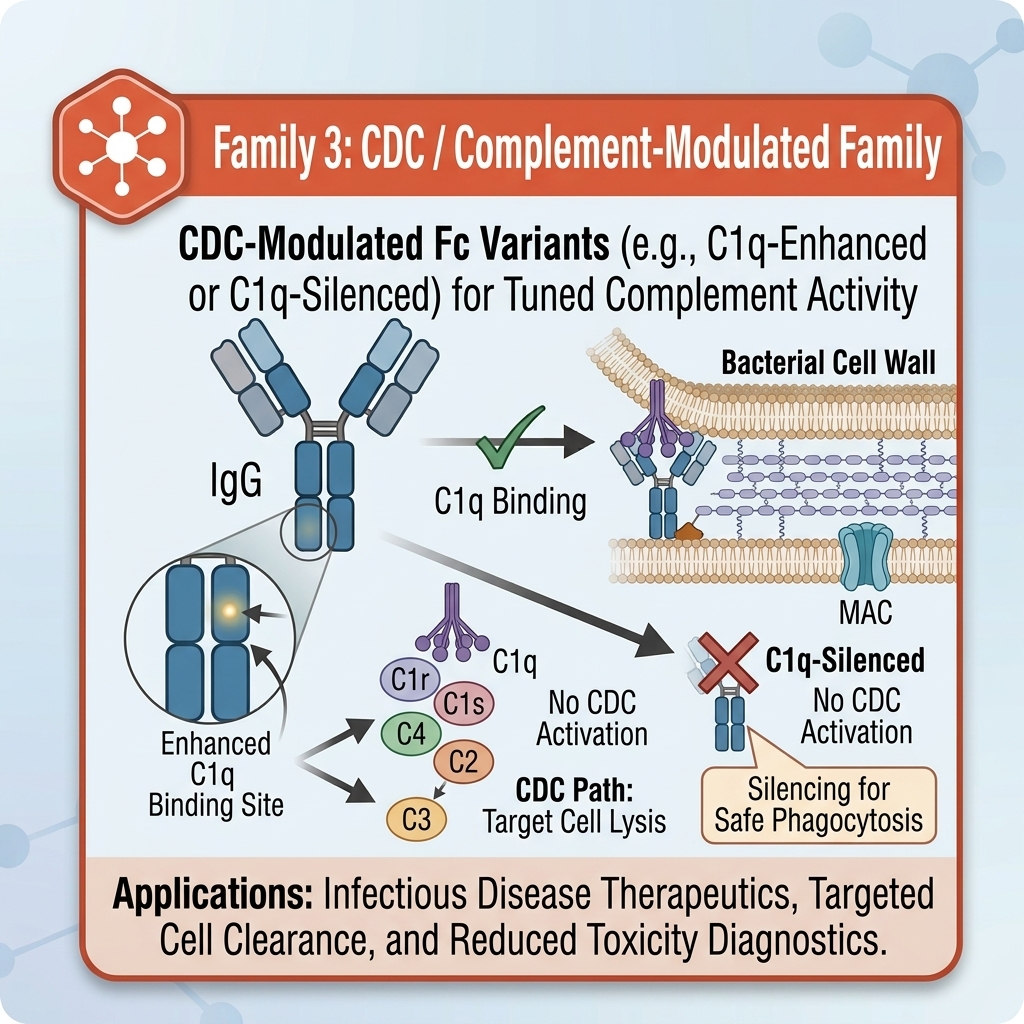
Fc Engineering Overview
The Human IgG1 (HexaBody-Extended: E345K/E430G/E431K) Fc variant introduces a premium triple mutation in the CH3 domain designed to maximize intermolecular Fc-Fc interactions and drive ultra-efficient cell-surface hexamerization. This engineering achieves maximal CDC potency even against targets with ultra-low antigen density while maintaining baseline FcγR binding and normal FcRn-mediated stability.
Functional Profile
| Property | Effect |
|---|---|
| FcγRI/II/III binding | Normal / WT Baseline |
| ADCC & ADCP | Normal / WT Baseline |
| CDC | Hyper-Enhanced ↑↑↑↑↑ (Maximum C1q avidity) |
| FcRn binding | Normal / WT Baseline |
| Serum half-life | Normal / WT Baseline |
| Effector potency | Maximum CDC Potency (Top-tier complement activation) |
Mechanism of Action
The HexaBody-Extended Fc variant combines three strategically engineered CH3-domain substitutions—Glu345 to Lys, Glu430 to Gly, and Glu431 to Lys:
- E345K & E431K Substitutions: Create complementary salt bridges and electrostatic networks across adjacent Fc monomers.
- E430G Substitution: Provides loop flexibility to optimize intermolecular alignment.
Upon antigen binding, this triple mutation dramatically lowers the threshold required for on-cell Fc-Fc self-assembly into hexameric platforms. The resulting ring structure presents six optimal binding sites for C1q, driving hyper-potent complement cascade activation and membrane attack complex (MAC) assembly.
Phenotypic Effects
- Peak complement-dependent cytotoxicity (CDC) potency across the Fusion BioLabs catalog.
- Triggers robust complement activation on targets with very low antigen expression or target density.
- Preserves wild-type FcγR engagement and baseline cell-mediated cytotoxicity (ADCC/ADCP).
- Retains native FcRn endosomal recycling and systemic clearance kinetics.
- Maintains standard monomeric IgG stability in solution prior to antigen engagement.
Applications
- Therapeutic antibody programs targeting ultra-low density or refractory cell-surface antigens.
- High-potency oncology therapeutics requiring maximum complement-mediated target depletion.
- Anti-pathogen antibodies targeting sparse viral envelope or bacterial surface proteins.
- Benchmark standard for evaluating the upper thermodynamic limits of Fc hexamerization.
Plasmid Map & Feature Annotation
Insert Structure: VH – CH1 – hinge – CH2(wild-type) – CH3(E345K/E430G/E431K)
- VH: Variable heavy domain
- CH1: Constant heavy 1
- Hinge: Native IgG1 hinge
- CH2 (wild-type): Native IgG1 CH2 domain (retains N297 glycosylation)
- CH3 (E345K/E430G/E431K): Hyper-hexamerization triple mutation
Fusion BioLabs Complement Modulated Family Comparison Matrix
| Variant | Mechanism | Complement Effect | Primary Application & Notes |
|---|---|---|---|
| human IgG1 (WT) Wild-Type |
Native C1q binding | ★★☆☆☆ | Baseline Control. Standard physiological C1q binding and CDC baseline for comparative assays. |
| human IgG1 (HexaBody-Extended) E345K / E430G / E431K |
On-cell hexamerization | ★★★★★+ | This Product. Hyper-CDC Enhancer. Triple mutation maximizing Fc-Fc intermolecular interactions; yields ultra-potent C1q avidity against ultra-low density antigen targets. |
| human IgG1 (HexaBody) E345K / E430G |
On-cell hexamerization | ★★★★★ | Canonical CDC-Boosting Fc. Enhances cell-surface hexamer assembly upon antigen binding to drastically boost C1q recruitment and membrane attack complex (MAC) formation. |
| human IgG1 (SEHF) S267E / H268F |
C1q binding loop enhancement | ★★★★☆ | High-Potency CDC Enhancer. Optimizes local electrostatic and structural interactions with C1q to boost complement lysis without requiring hexamerization. |
| human IgG1 (WS) K326W / E333S |
C1q binding loop enhancement | ★★★☆☆ | Strong CDC Enhancer. Synergistic double mutation in CH2 that significantly increases C1q binding affinity and complement killing. |
| human IgG1 (K322A) K322A |
C1q contact site ablation | ★☆☆☆☆ | Selective Human IgG1 CDC-Null. Abolishes C1q binding and CDC while maintaining native FcγR engagement (ADCC+/ADCP+). |
| human IgG2 (K322A) K322A |
C1q contact site ablation | ★☆☆☆☆ | Completely Silent Human IgG2 Control. Eliminates residual IgG2 C1q binding to yield a fully inert neutralizer (ADCCnull/ADCPnull/CDCnull). |
| mouse IgG2a (CompNull) L235E + E318A / K320A / K322A |
Complement binding triad ablation | ★☆☆☆☆ | Murine CDC-Null Control. Completely abolishes complement activation in murine models while preserving mouse FcγR engagement for syngeneic in vivo studies. |
Storage & Handling
- Store plasmid at −20°C.
- Avoid repeated freeze–thaw cycles.
- Use sterile technique when handling.
- Suitable for transient or stable mammalian expression.
References
- Diebolder CA, Beurskens FJ, de Jong RN, Koning RI, Strumane K, Lindorfer MA, Voorhorst M, Ugurlar D, Rosati S, Heck AJ, van de Winkel JG, Wilson IA, Koster AJ, Taylor RP, Saphire EO, Burton DR, Schuurman J, Gros P, Parren PW. Complement is activated by IgG hexamers assembled at the cell surface. Science. 2014;343(6176):1260-1263.
- de Jong RN, Beurskens FJ, Verploegen S, Strumane K, van Kampen MD, Voorhorst M, Horstman W, Engelberts PJ, Oostindie SC, Wang G, Heck AJ, Schuurman J, Parren PW. A Novel Platform for the Potentiation of Therapeutic Antibodies Based on Antigen-Dependent Formation of IgG Hexamers at the Cell Surface. PLoS Biol. 2016;14(1):e1002344.