Fc Engineering Overview
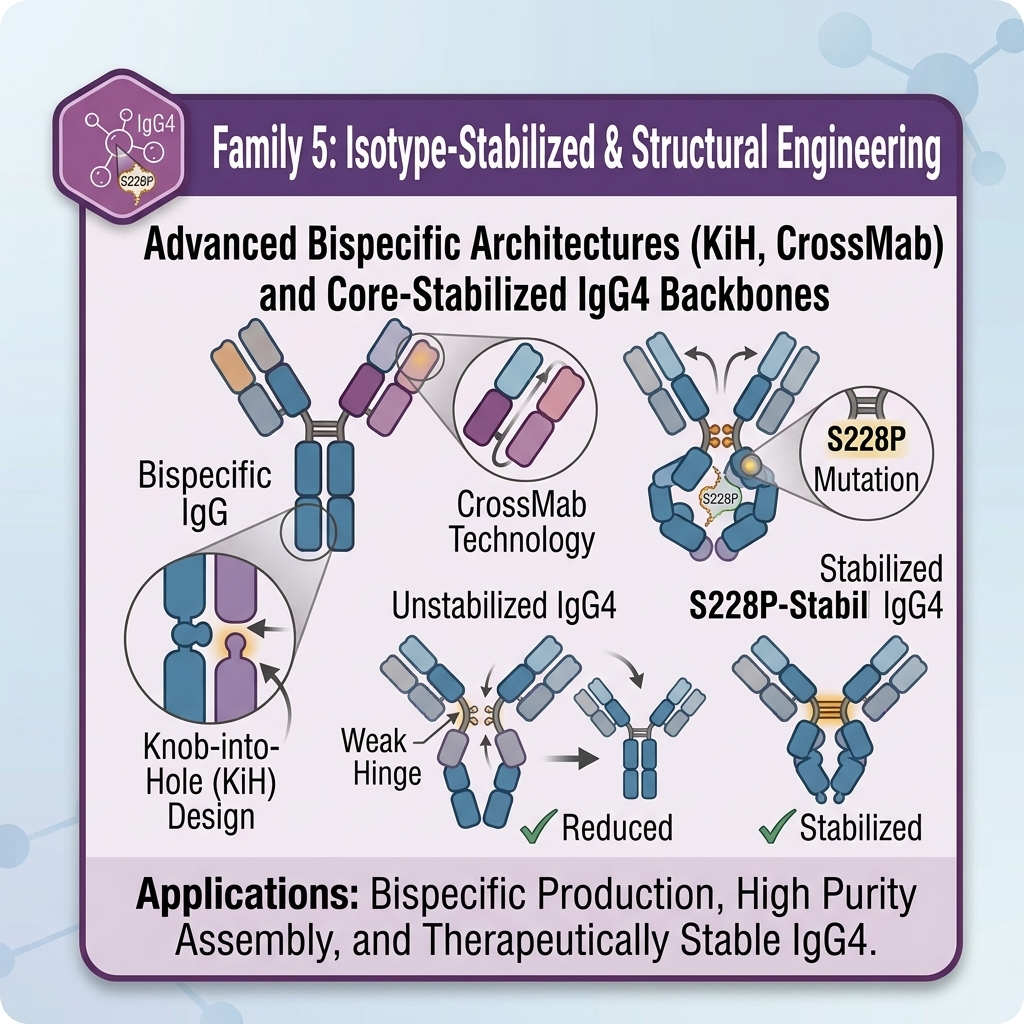
The Human IgG4 (S228P) — IgG4-Stabilized Core Hinge Isotype Vector replaces the wild-type serine at residue 228 with a proline in the IgG4 core hinge (CPSC → CPPC). Wild-type IgG4 exhibits inter-heavy chain disulfide bond instability, leading to dynamic in vivo Fab-arm exchange (half-antibody formation). By restoring the IgG1-like core hinge proline, this variant permanently stabilizes inter-heavy chain disulfides, preventing Fab-arm exchange while maintaining characteristically low IgG4 effector activity.
Functional Profile
| Property | Effect |
|---|---|
| Fab-Arm Exchange (in vivo) | Completely Abolished (0%) |
| Inter-chain Disulfide Integrity | High (>98% intact IgG4 monomer) |
| FcγRI (CD64) binding | Low / Retains native IgG4 profile |
| FcγRII/III binding | Extremely Low / Negligible |
| C1q binding / CDC | Undetectable / Null |
| FcRn binding & half-life | Normal / Baseline IgG circulation |
Mechanism of Action
Core Hinge Rigidification: Wild-type IgG4 core hinge undergoes intra-chain disulfide folding, leading to non-covalent, reversible heavy-chain dissociation into half-molecules (H1L1).
S228P Substitution: Re-introduces the rigid CPPC motif found in IgG1, forcing 100% inter-chain disulfide bond formation between heavy chains and locking the bivalent H2L2 antibody assembly.
Phenotypic Effects
- Prevents in vivo Fab-arm exchange and bispecific recombination with endogenous host IgG4 antibodies.
- Increases hinge structural stability and thermal tolerance.
- Maintains native IgG4 profile with minimal effector function.
- Significantly improves structural homogeneity during recombinant expression and long-term storage.
- Eliminates half-antibody species in therapeutic or diagnostic production runs.
Applications
- Clinical gold standard for non-depleting therapeutic antibodies (e.g., anti-PD-1 checkpoint blockers like pembrolizumab and nivolumab).
- Blocking receptor-ligand interactions without immune cell clearance or cell lysis.
- Monovalent or bivalent binding applications where structural stability is mandatory.
Sequence Map & Feature Annotation
Insert Architecture: VH – CH1 – hinge(S228P) – CH2(WT) – CH3(WT)
- VH: Variable heavy domain
- CH1: Constant heavy 1
- Hinge(S228P): Stabilized IgG4 core hinge region (CPPC)
- CH2: Constant heavy 2 (WT)
- CH3: Constant heavy 3 (WT)
Storage & Handling
Plasmid: Store at −20 °C
Purified antibody:
- 2–8 °C for short-term storage
- −80 °C for long-term storage
- Avoid repeated freeze–thaw cycles
- Use sterile technique for all handling
- Optimized for transient or stable expression in mammalian expression systems (CHO, HEK293)
References
- Angal S, King DJ, Bodmer MW, Turner A, Lawson AD, Roberts G, Pedley B, Adair JR. A single amino acid substitution abolishes the heterogeneity of chimeric mouse/human (IgG4) antibody. Mol Immunol. 1993;30(1):105-108.
- Silva JP, Vetterlein O, Jose J, Peters S, Kirby H. The S228P mutation prevents in vivo and in vitro IgG4 Fab-arm exchange as demonstrated using a combination of novel quantitative immunoassays and physiological matrix preparation. J Biol Chem. 2015; 290(9):5462-5469.