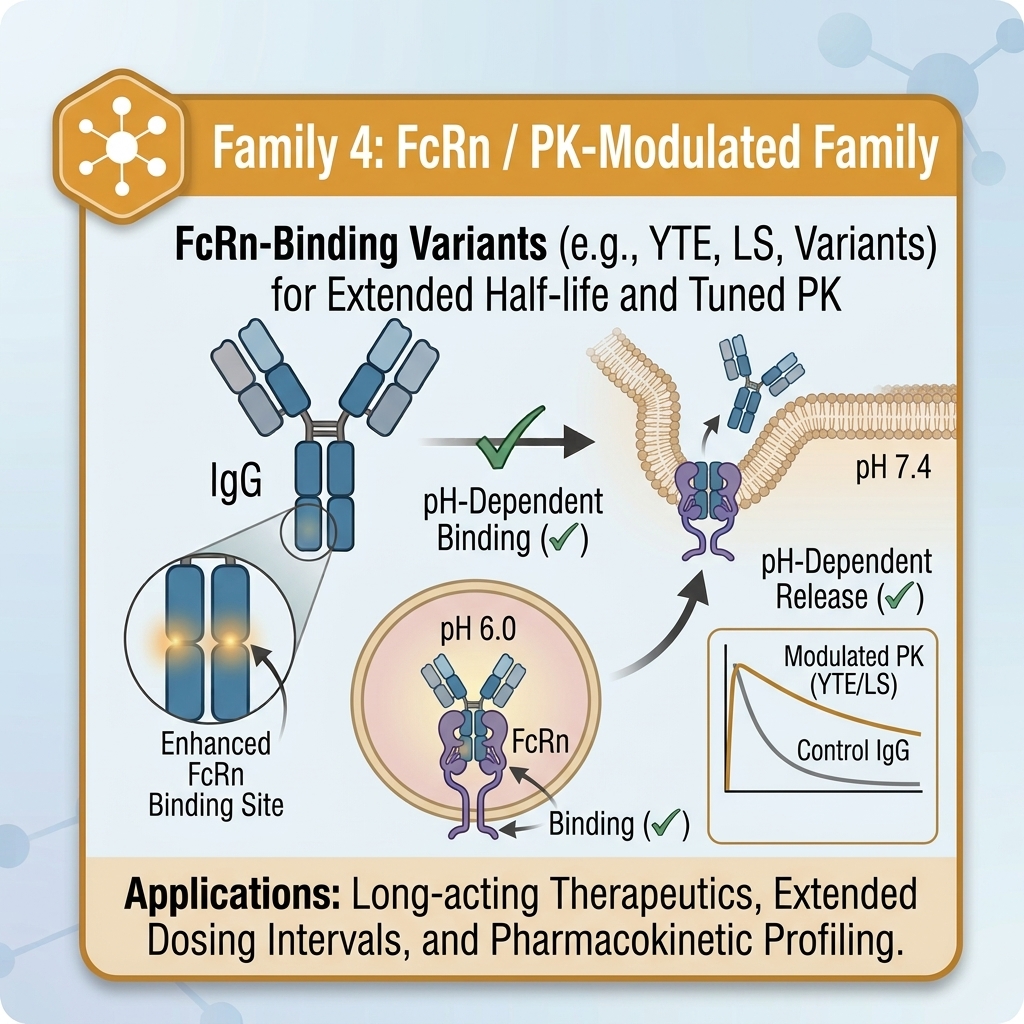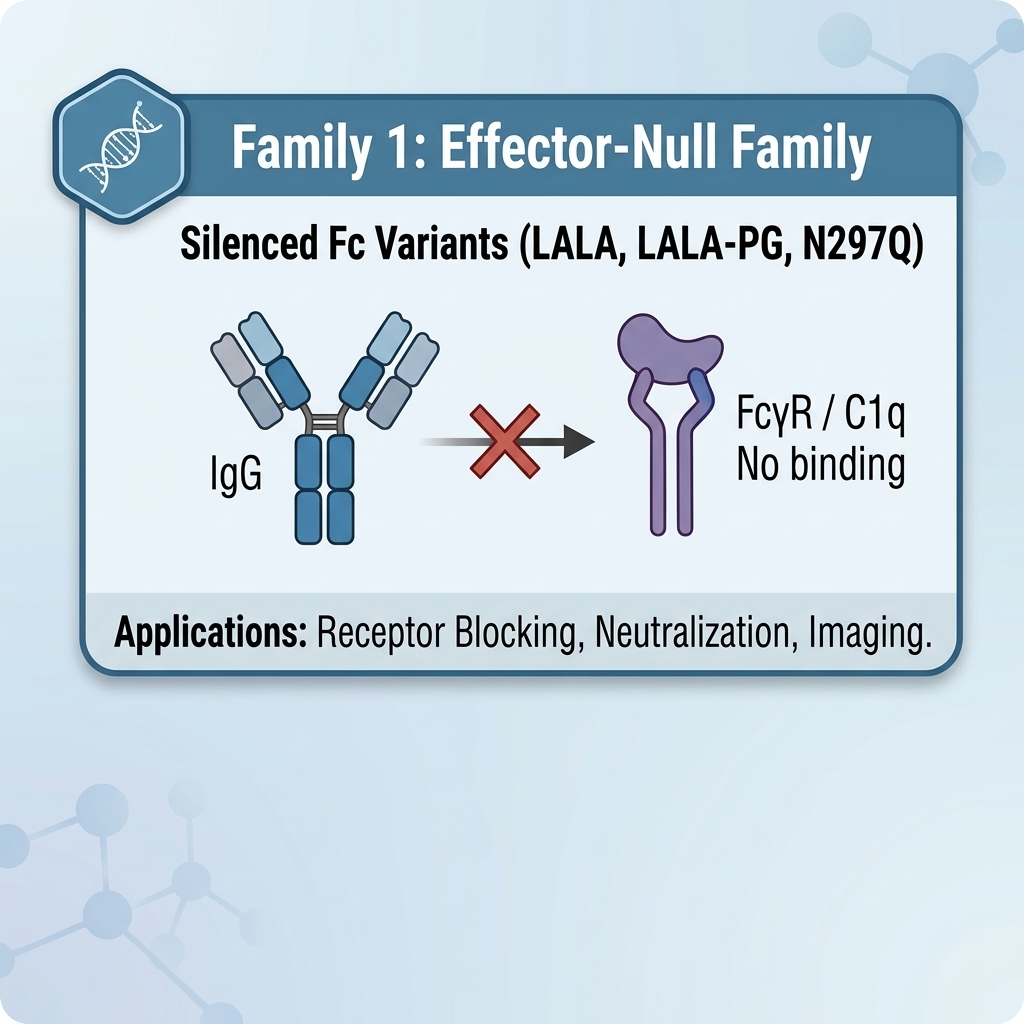
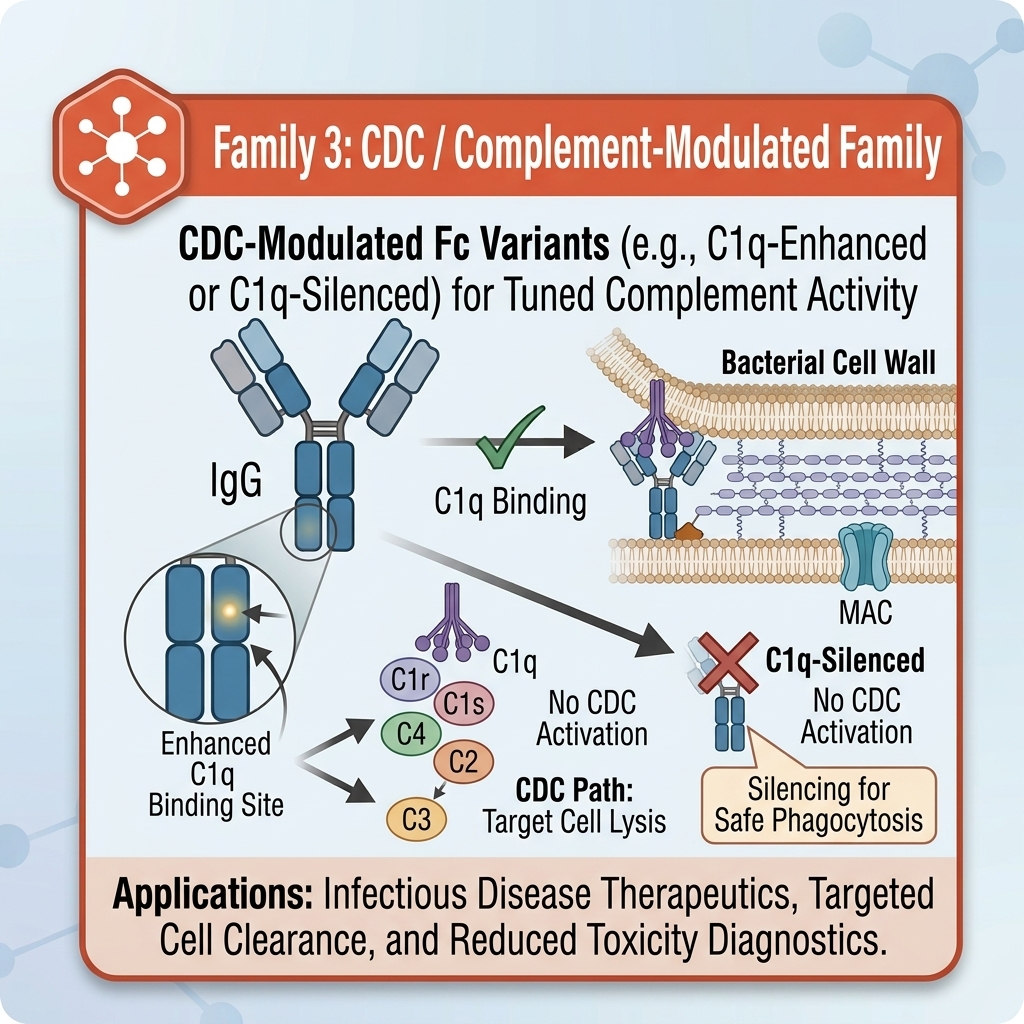
Fc Engineering Overview
The Human IgG2 (K322A) Fc variant introduces a targeted single amino acid substitution into the human IgG2 CH2 domain to ablate residual C1q binding. This yields a completely inert Fc backbone devoid of both FcγR engagement and complement activity (ADCCnull / ADCPnull / CDCnull) while preserving standard FcRn recycling kinetics.
Functional Profile
| Property | Effect |
|---|---|
| FcγR binding (I, IIa, IIIa) | Non-binding / Inert Baseline (IgG2 native profile) |
| ADCC & ADCP | Completely Inactive / Null |
| CDC | Fully Ablated ↓↓↓ (Absolute CDC-Null) |
| FcRn binding | Normal / WT Baseline |
| Serum half-life | Normal / WT Baseline |
| Effector potency | Completely Silent (ADCCnull / ADCPnull / CDCnull) |
Mechanism of Action
While human wild-type IgG2 exhibits intrinsically minimal FcγR engagement, it retains low-level residual capacity to bind C1q and initiate complement activation under high antigen density conditions. The K322A mutation replaces the pivotal lysine at position 322 with alanine (Lys322 to Ala) within the CH2 domain. Disruption of this core ionic contact point completely abolishes C1q recruitment without affecting the native IgG2 disulfide structural framework or FcRn interactions at the CH2-CH3 interface.
Phenotypic Effects
- Complete abolition of residual C1q binding and complement-dependent cytotoxicity (CDC).
- Retains the intrinsically low FcγR binding profile of wild-type human IgG2 (ADCC/ADCPnull).
- Creates a completely silent human Fc scaffold for blocking or receptor-neutralizing applications.
- Preserves normal FcRn binding, endosomal recycling, and systemic half-life.
Applications
- Receptor-blocking or ligand-neutralizing antibodies requiring zero effector function.
- Antagonistic therapeutic candidates where target lysis or immune cell engagement is undesirable.
- Negative control vector for isolating FAB-mediated target engagement from Fc-mediated biological responses.
- Preclinical formulation of agonist antibodies requiring pure target cross-linking without Fc-mediated clearance.
Plasmid Map & Feature Annotation
Insert Structure: VH – CH1 – hinge – CH2(K322A) – CH3
- VH: Variable heavy domain
- CH1: Constant heavy 1
- Hinge: Native IgG2 hinge
- CH2(K322A): Complement-ablating single mutation in IgG2
- CH3: Native IgG2 CH3
Fusion BioLabs Complement Modulated Family Comparison Matrix
| Variant | Mechanism | Complement Effect | Primary Application & Notes |
|---|---|---|---|
| human IgG1 (WT) Wild-Type |
Native C1q binding | ★★☆☆☆ | Baseline Control. Standard physiological C1q binding and CDC baseline for comparative assays. |
| human IgG1 (HexaBody-Extended) E345K / E430G / E431K |
On-cell hexamerization | ★★★★★+ | Hyper-CDC Enhancer. Triple mutation maximizing Fc-Fc intermolecular interactions; yields ultra-potent C1q avidity against ultra-low density antigen targets. |
| human IgG1 (HexaBody) E345K / E430G |
On-cell hexamerization | ★★★★★ | Canonical CDC-Boosting Fc. Enhances cell-surface hexamer assembly upon antigen binding to drastically boost C1q recruitment and membrane attack complex (MAC) formation. |
| human IgG1 (SEHF) S267E / H268F |
C1q binding loop enhancement | ★★★★☆ | High-Potency CDC Enhancer. Optimizes local electrostatic and structural interactions with C1q to boost complement lysis without requiring hexamerization. |
| human IgG1 (WS) K326W / E333S |
C1q binding loop enhancement | ★★★☆☆ | Strong CDC Enhancer. Synergistic double mutation in CH2 that significantly increases C1q binding affinity and complement killing. |
| human IgG1 (K322A) K322A |
C1q contact site ablation | ★☆☆☆☆ | Selective Human IgG1 CDC-Null. Abolishes C1q binding and CDC while maintaining native FcγR engagement (ADCC+/ADCP+). |
| human IgG2 (K322A) K322A |
C1q contact site ablation | ★☆☆☆☆ | This Product. Completely Silent Human IgG2 Control. Eliminates residual IgG2 C1q binding to yield a fully inert neutralizer (ADCCnull/ADCPnull/CDCnull). |
| mouse IgG2a (CompNull) L235E + E318A / K320A / K322A |
Complement binding triad ablation | ★☆☆☆☆ | Murine CDC-Null Control. Completely abolishes complement activation in murine models while preserving mouse FcγR engagement for syngeneic in vivo studies. |
Storage & Handling
- Store plasmid at −20°C.
- Avoid repeated freeze–thaw cycles.
- Use sterile technique when handling.
- Suitable for transient or stable mammalian expression.
References
- Tao MH, Smith RI, Morrison SL. Structural features of human immunoglobulin G that determine isotype-specific differences in complement activation. J Exp Med. 1993;178(2):661-667.
- Idusogie EE, Presta LG, Gazzano-Santoro H, Totpal K, Wong PY, Ultsch M, Meng YG, Mulkerrin MG. Mapping of the C1q binding site on rituxan, a chimeric antibody with a human IgG1 Fc. J Immunol. 2000;164(8):4178-4184.
- Tam SH, McCarthy SG, Armstrong AA, Somani S, Wu SJ, Liu X, Gervais A, Ernst R, Saro D, Decker R, Luo J, Gilliland GL, Chiu ML, Scallon BJ. Functional, Biophysical, and Structural Characterization of Human IgG1 and IgG4 Fc Variants with Ablated Immune Functionality. Antibodies (Basel). 2017;6(3):12.