Fc Engineering Overview
The Mouse IgG2a (Comp-Null) Fc variant introduces four coordinated substitutions in the CH2 domain engineered to completely abolish C1q binding and complement activation in murine models while preserving native mouse FcγR engagement (ADCC+ / ADCP+) and FcRn recycling kinetics.
Functional Profile
| Property | Effect |
|---|---|
| Mouse FcγRI/IIb/III/IV binding | Normal / WT Baseline |
| ADCC & ADCP | Normal / WT Baseline |
| CDC | Completely Ablated ↓↓↓ (CDC-Null) |
| FcRn binding | Normal / WT Baseline |
| Serum half-life | Normal / WT Baseline |
| Effector potency | Selective Murine CDC-Null (ADCC+ / ADCP+ / CDCnull) |
Mechanism of Action
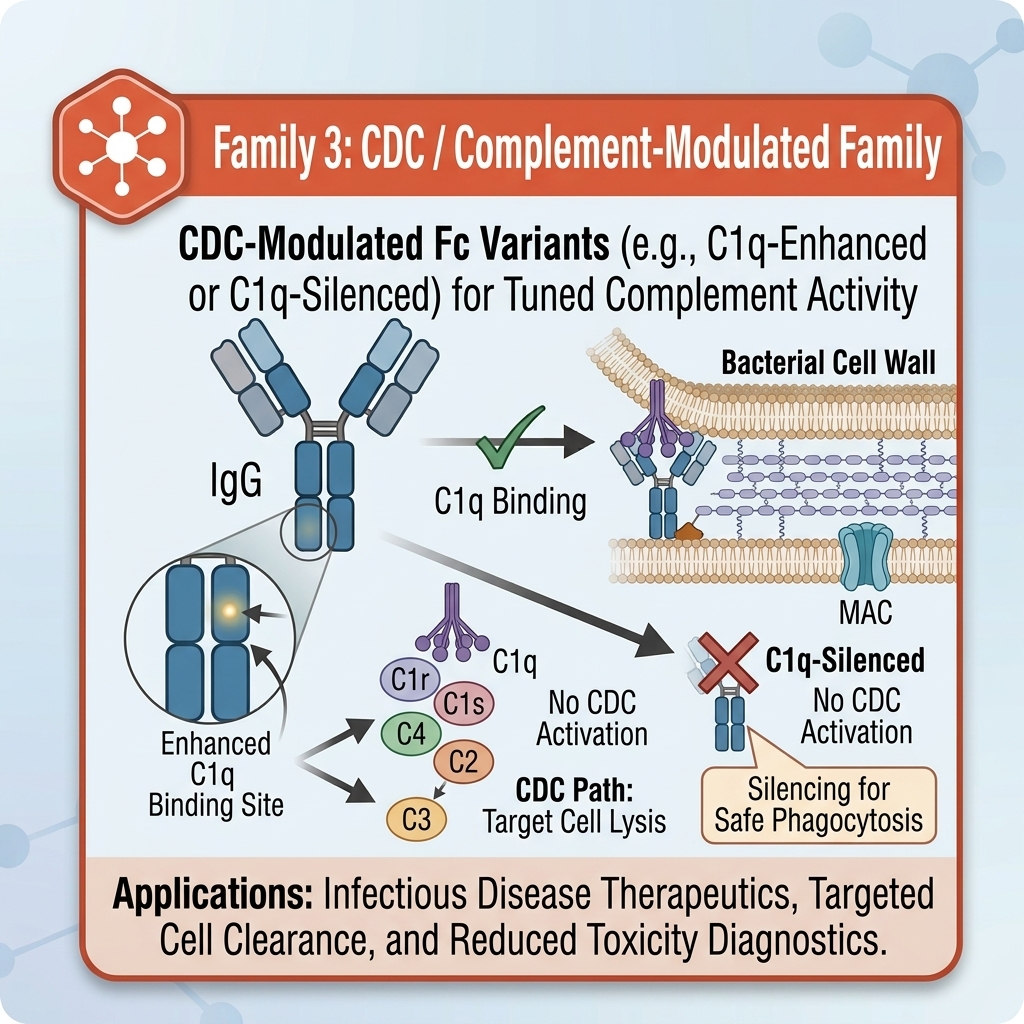
The mouse IgG2a CompNull Fc variant targets two core elements of the classical complement activation interface within the CH2 domain. Leu235 to Glu alters the hydrophobic lower-hinge region required for optimal C1q docking. Concurrently, Glu318 to Ala, Lys320 to Ala, and Lys322 to Ala ablate the canonical C1q-binding motif (the “E-K-K triad”). Together, these four modifications eliminate C1q recruitment and downstream membrane attack complex (MAC) assembly while keeping the mouse FcγR and FcRn interaction surfaces intact.
Phenotypic Effects
- Absolute loss of C1q binding affinity and complement-dependent cytotoxicity (CDC).
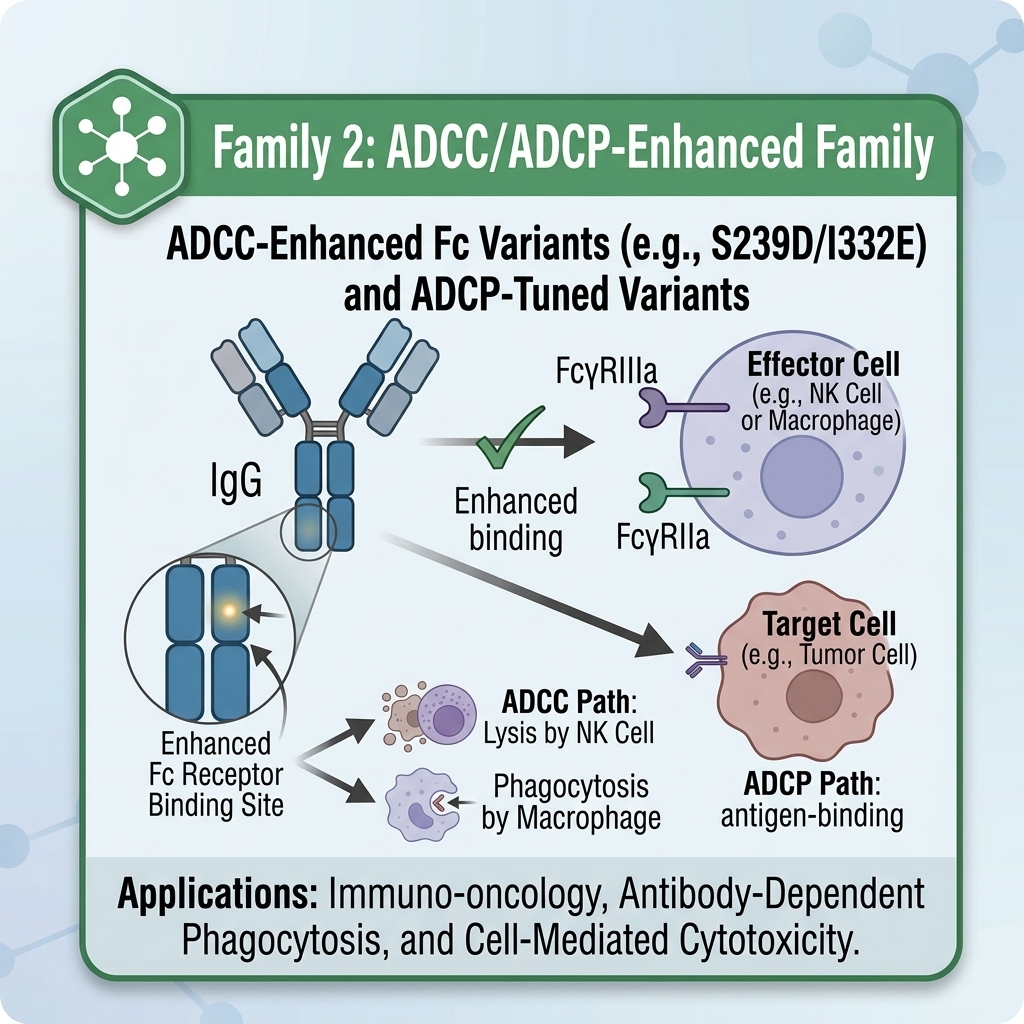
- Full preservation of native mouse FcγR engagement, mediating intact ADCC and ADCP.
- Eliminates complement-mediated systemic activation or toxicity in syngeneic mouse models.
- Preserves normal FcRn endosomal recycling and systemic clearance kinetics.
Applications
- Syngeneic mouse in vivo studies requiring complete elimination of complement activation.
- Mechanistic dissection separating FcγR-mediated cellular effector functions from complement activation.
- Development of safety-optimized surrogate mouse antibodies for translational evaluation.
- Murine equivalent/control for human CDC-null variants (e.g., human IgG1 K322A).
Plasmid Map & Feature Annotation
Insert Structure: VH – CH1 – hinge – CH2(L235E/E318A/K320A/K322A) – CH3(wild-type)
- VH: Variable heavy domain
- CH1: Constant heavy 1
- Hinge: Native mouse IgG2a hinge
- CH2(L235E/E318A/K320A/K322A): Complement-binding triad ablation mutation set
- CH3(wild-type): Native mouse IgG2a CH3 domain
Fusion BioLabs Complement Modulated Family Comparison Matrix
| Variant | Mechanism | Complement Effect | Primary Application & Notes |
|---|---|---|---|
| human IgG1 (WT) Wild-Type |
Native C1q binding | ★★☆☆☆ | Baseline Control. Standard physiological C1q binding and CDC baseline for comparative assays. |
| human IgG1 (HexaBody-Extended) E345K / E430G / E431K |
On-cell hexamerization | ★★★★★+ | Hyper-CDC Enhancer. Triple mutation maximizing Fc-Fc intermolecular interactions; yields ultra-potent C1q avidity against ultra-low density antigen targets. |
| human IgG1 (HexaBody) E345K / E430G |
On-cell hexamerization | ★★★★★ | Canonical CDC-Boosting Fc. Enhances cell-surface hexamer assembly upon antigen binding to drastically boost C1q recruitment and membrane attack complex (MAC) formation. |
| human IgG1 (SEHF) S267E / H268F |
C1q binding loop enhancement | ★★★★☆ | High-Potency CDC Enhancer. Optimizes local electrostatic and structural interactions with C1q to boost complement lysis without requiring hexamerization. |
| human IgG1 (WS) K326W / E333S |
C1q binding loop enhancement | ★★★☆☆ | Strong CDC Enhancer. Synergistic double mutation in CH2 that significantly increases C1q binding affinity and complement killing. |
| human IgG1 (K322A) K322A |
C1q contact site ablation | ★☆☆☆☆ | Selective Human IgG1 CDC-Null. Abolishes C1q binding and CDC while maintaining native FcγR engagement (ADCC+/ADCP+). |
| human IgG2 (K322A) K322A |
C1q contact site ablation | ★☆☆☆☆ | Completely Silent Human IgG2 Control. Eliminates residual IgG2 C1q binding to yield a fully inert neutralizer (ADCCnull/ADCPnull/CDCnull). |
| mouse IgG2a (Comp-Null) L235E + E318A / K320A / K322A |
Complement binding triad ablation | ★☆☆☆☆ | This Product. Murine CDC-Null Control. Completely abolishes complement activation in murine models while preserving mouse FcγR engagement for syngeneic in vivo studies. |
Storage & Handling
- Store plasmid at −20°C.
- Avoid repeated freeze–thaw cycles.
- Use sterile technique when handling.
- Suitable for transient or stable mammalian expression.
References
- Duncan AR, Woof JM, Partridge LJ, Burton DR, Winter G. Localization of the binding site for the human high-affinity Fc receptor on IgG. Nature. 1988;332(6164):563-564.
- Duncan AR, Winter G. The binding site for C1q on IgG. Nature. 1988;332(6166):738-740.