Plasmid Name
pHC-IgG1(ΔG236)
Mutation Set
ΔG236
Selection Marker
Ampicillin
Promoter
CMV
Fc Engineering Overview
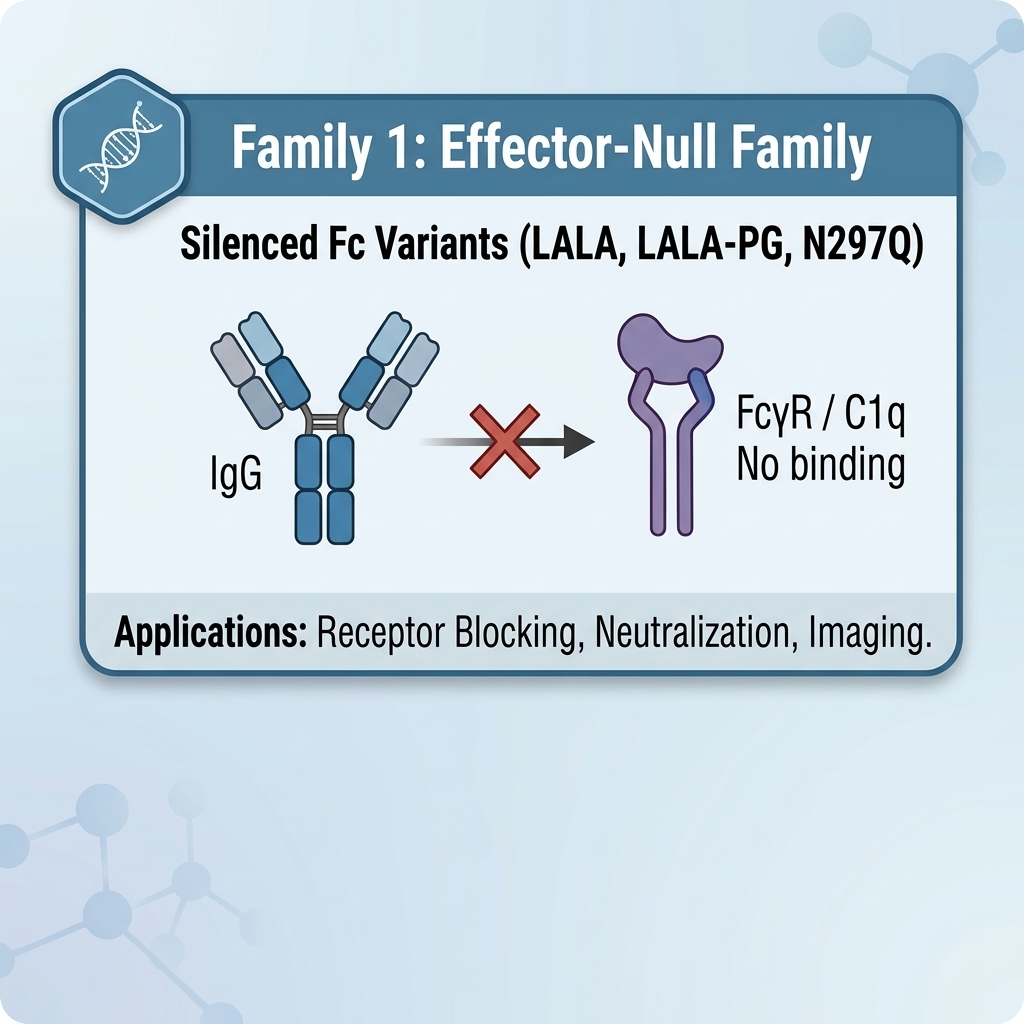
The human IgG1 (ΔG236) Fc variant features a minimalist, single-residue Fc modification that selectively abolishes FcγR engagement and cellular effector functions (ADCC/ADCP) while preserving native CH2 N-glycosylation, structural thermal stability, and baseline complement engagement.
Functional Profile
| Property | Effect |
|---|---|
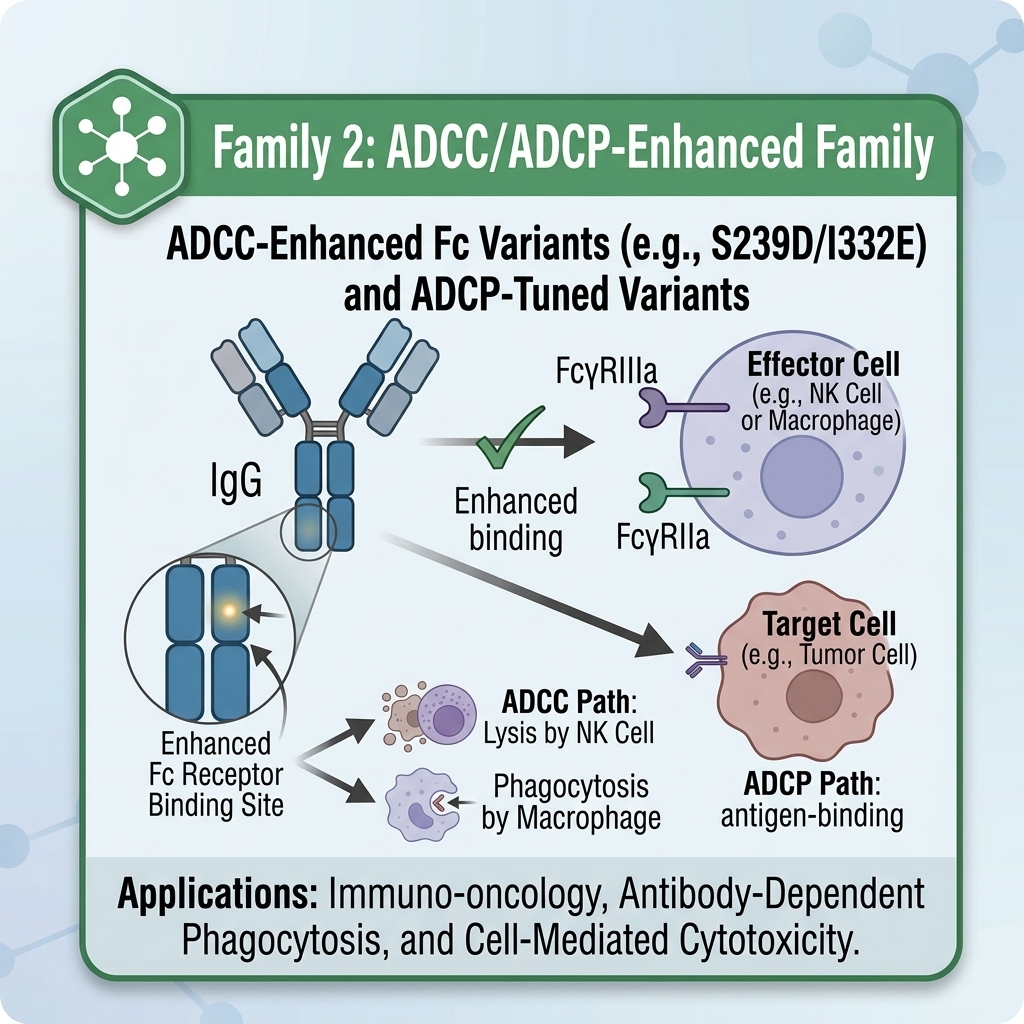
| FcγRI/IIa/IIb/IIIa binding | Severely Suppressed / Abolished ↓↓↓ |
| ADCC | Severely Reduced / Minimal ↓↓↓ |
| ADCP (Macrophage Phagocytosis) | Severely Reduced / Minimal ↓↓↓ |
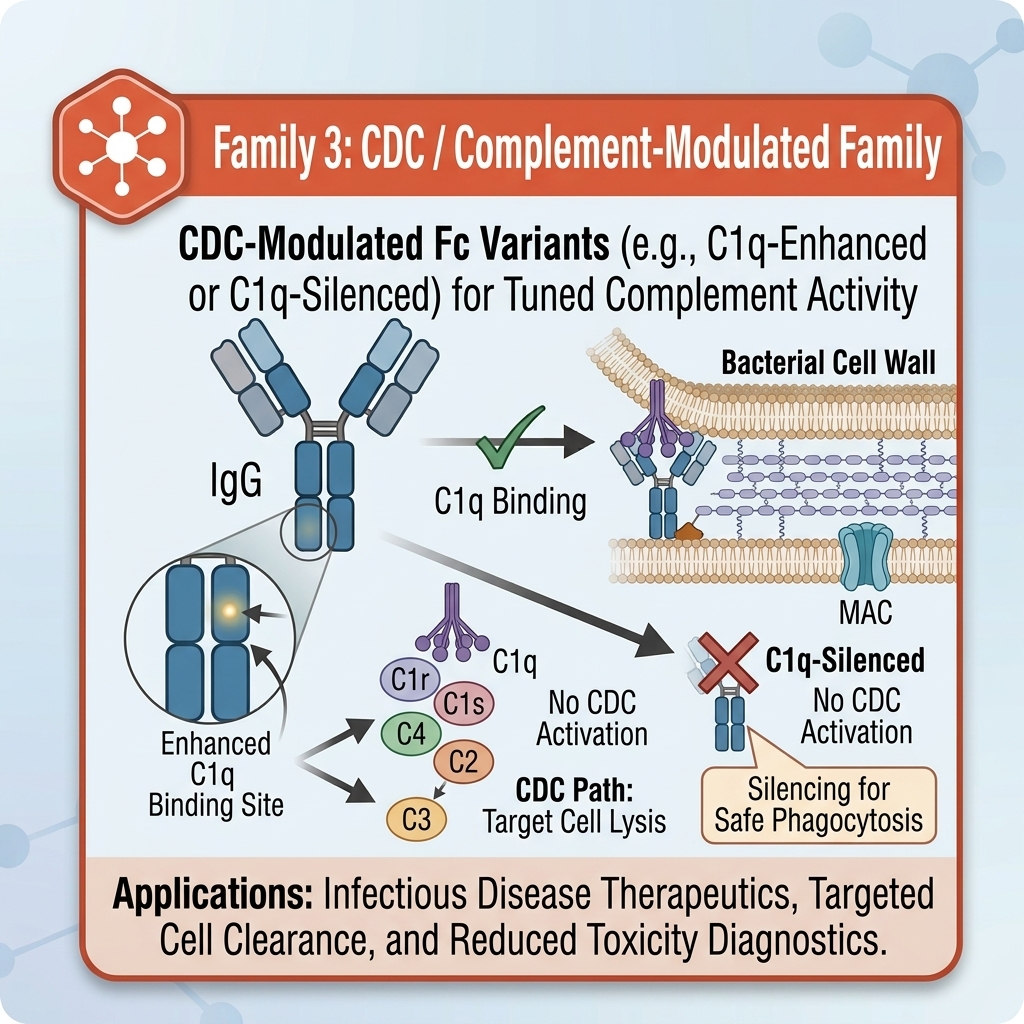
| C1q binding | Preserved / Baseline (WT-like loop integrity) |
| CDC | Preserved / Mildly Attenuated |
| FcRn binding & half-life | Normal / WT Baseline |
| Glycosylation & Stability | Intact (N297 glycan retained; high thermal stability Tm ≈ 70°C) |
Mechanism of Action
Deletion of Glycine 236 (ΔG236) operates via a targeted structural dislocation of the lower hinge:
- Lower Hinge Contraction: Glycine 236 forms the crucial structural pivot point at the lower hinge-CH2 junction (EU residues 231–236). Deleting this single residue shortens the lower hinge loop, preventing the conformational flexibility required to fit into the extracellular ligand-binding cleft of FcγR receptors.
- Preservation of C1q & N-Glycan Sites: Because the deletion is restricted entirely to the lower hinge, downstream CH2 structural loops—including the core N297 glycosylation site and the C1q binding site (K322/P329/P331)—remain intact.
Phenotypic Effects
- Profound loss of binding across all activating (FcγRI, FcγRIIa, FcγRIIIa) and inhibitory (FcγRIIb) receptors.
- Eliminates NK cell ADCC and macrophage ADCP cytotoxicity.
- Maintains standard FcRn endosomal recycling and in vivo systemic half-life.
- Preserves physiological N-glycosylation and native CH2 domain thermal stability (Tm ≈ 70°C).
Applications
- Therapeutic formats requiring selective cellular silencing without aglycosylation.
- Bispecific antibodies and receptor traps where FcγR cross-linking causes off-target toxicity.
- Mechanistic controls comparing single-residue lower hinge modifications against multi-point mutants (LALA-PG, EN).
- Diagnostic and imaging reagents requiring FcRn-mediated extended persistence without cellular effector activation.
Plasmid Map & Feature Annotation
Insert Structure: VH – CH1 – hinge – lower hinge(ΔG236) – CH2(wild-type) – CH3(wild-type)
- VH: Variable heavy domain
- CH1: Constant heavy 1
- Hinge: Native IgG1 core hinge
- Lower Hinge (ΔG236): Single-residue lower hinge deletion site
- CH2 (WT): Wild-type CH2 domain containing intact N297 glycosylation site
- CH3 (WT): Native IgG1 CH3 domain
Product Note: The human IgG1 (ΔG236) variant offers a structurally elegant alternative to heavily mutated Fc-null designs. By utilizing a single deletion rather than introducing multiple non-native amino acid substitutions, ΔG236 minimizes immunogenicity risks while delivering potent selective FcγR silencing.
Fusion BioLabs EffectorNull Family Comparison Matrix
| Variant | Mechanism | Silencing Strength | Notes |
|---|---|---|---|
| human IgG1 (WT) | Wild-Type baseline | Baseline | Human WT Control. Native FcγR and C1q binding; fully active baseline control. |
| mouse IgG2a (WT) | Wild-Type baseline | Baseline | Murine WT Control. Native mouse FcγR and complement binding; active control for syngeneic models. |
| human IgG1 (EN / Armour) E233P / L234V / L235A / ΔG236 + A327G / A330S / P331S |
Lower hinge & CH2 chimeric sequence substitution | ★★★★★ | Ultra-Silent Chimeric Null. Cross-subclass IgG2/IgG4 sequence replacement; abolishes FcγR & CDC engagement. |
| human IgG1 (LALA-PG) L234A / L235A / P329G |
Lower hinge & CH2 proline-sandwich null | ★★★★★ | Clinical Gold Standard. Complete, double-silent suppression of all human FcγRs and C1q/CDC. |
| mouse IgG2a (LALA-PG) L234A / L235A / P329G |
Murine lower hinge & CH2 proline-sandwich | ★★★★★ | In Vivo Murine Gold Standard. Complete silencing of murine FcγRs and complement in syngeneic mouse models. |
| human IgG1 (LALA) L234A / L235A |
Lower hinge double alanine substitution | ★★★☆☆ | Classic Benchmark Control. Widely used legacy variant; retains minor residual FcγRI (CD64) binding. |
| human IgG1 (ΔG236) ΔG236 |
Lower hinge single residue deletion | ★★★☆☆ | This Product. Selective FcγR-Null. Dislocates FcγR binding site while preserving native N-glycan structure and C1q loops. |
| human IgG1 (N297Q) N297Q |
CH2 domain N-glycan site elimination | ★★★★☆ | Human Aglycosylated Control. Broad effector silencing via glycan removal; lowers thermal stability (Tm). |
| mouse IgG2a (N297Q) N297Q |
Murine CH2 domain N-glycan site elimination | ★★★★☆ | Murine Aglycosylated Control. Aglycosylated mouse control for in vivo preclinical rodent studies. |
Storage & Handling
- Store plasmid at −20°C.
- Avoid repeated freeze–thaw cycles.
- Handle using sterile technique.
- Suitable for transient or stable mammalian expression (CHO, HEK293, NS0).
References
- Brinkhaus M, Douwes RGJ, Bentlage AEH, Temming AR, de Taeye SW, Tammes Buirs M, Gerritsen J, Mok JY, Brasser G, Ligthart PC, van Esch WJE, Verheesen P, de Haard H, Rispens T, Vidarsson G. Glycine 236 in the Lower Hinge Region of Human IgG1 Differentiates FcγR from Complement Effector Function. J Immunol. 2020;205(12):3456-3467.
- Richards JO, Karki S, Lazar GA, Chen H, Dang W, Desjarlais JR. Optimization of antibody binding to FcgammaRIIa enhances macrophage phagocytosis of tumor cells. Mol Cancer Ther. 2008;7(8):2517-2527.