Fc Engineering Overview
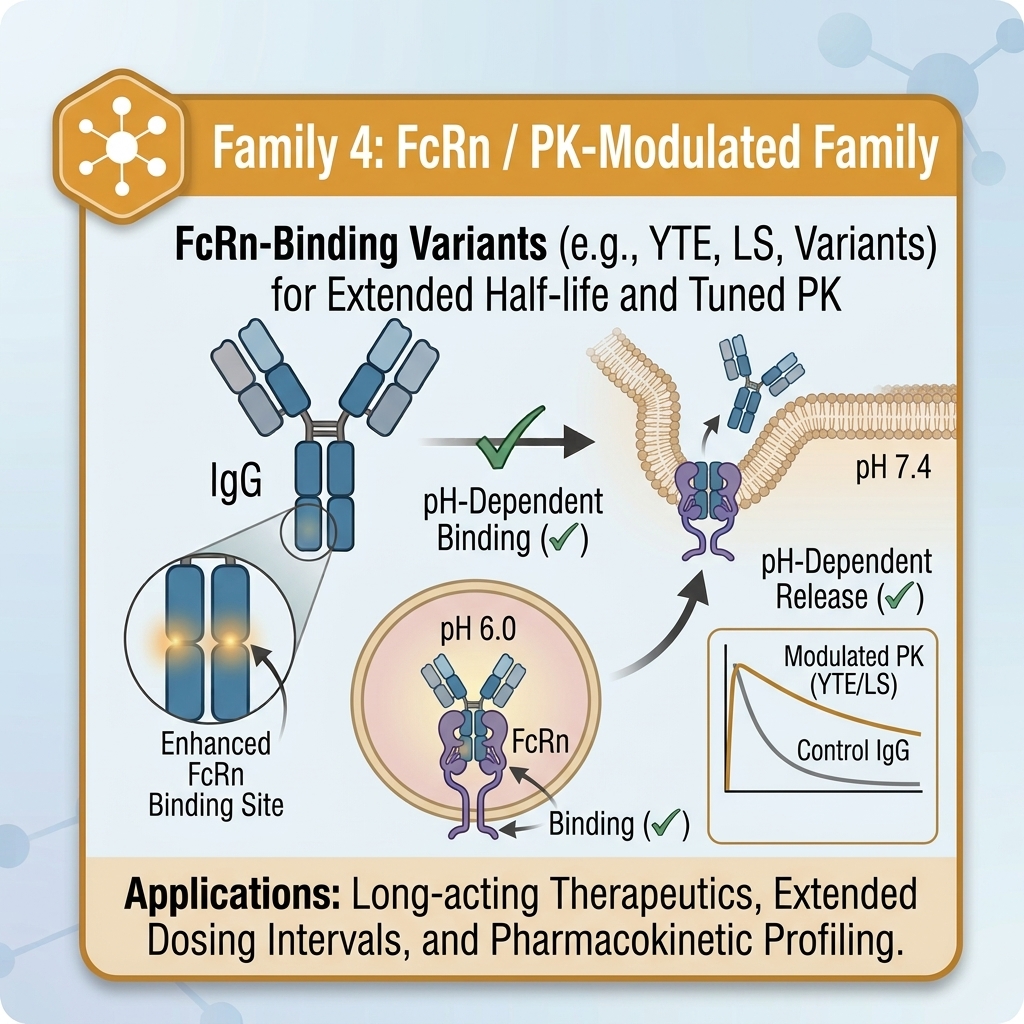
The Human IgG1 (N434A) — N434A Fc Variant introduces a single point substitution (Asn434 to Ala) in the CH3 domain designed to enhance FcRn binding affinity at acidic pH (pH 6.0) for moderate serum half-life extension (1.5–2×) with minimal risk of immunogenicity. By relying on a single conservative substitution, it offers an optimal balance between pharmacokinetic enhancement, maintained effector functions (ADCC, ADCP, CDC), and low engineering complexity.
Functional Profile
| Property | Effect |
|---|---|
| FcγR binding | Maintained / WT Baseline |
| ADCC | Maintained / WT Baseline |
| CDC | Maintained / WT Baseline |
| FcRn binding | Increased ↑ |
| Serum half-life | Extended ↑ (1.5-2 x) |
| PK profile | Moderately extended |
Mechanism of Action
The N434A Fc variant introduces a single point substitution—Asn434 to Ala—at the CH2-CH3 interface loop directly adjacent to the core FcRn binding site. This substitution increases hydrophobic interaction with FcRn inside acidic endosomal compartments (pH 6.0) while retaining complete pH-dependent release at physiological neutral environment (pH 7.4). Unlike multi-point variants, N434A selectively enhances endosomal recycling while preserving wild-type effector functions (FcγR engagement and complement activation).
Phenotypic Effects
- Moderately increased FcRn binding affinity at acidic pH (pH 6.0).
- Complete, efficient receptor release at physiological pH (pH 7.4).
- Extended serum half-life (1.5 -2 x clearance extension depending on species).
- Retains wild-type effector function (ADCC, ADCP, and CDC).
- Low immunogenicity risk due to a single solvent-exposed residue change.
- Preserves high expression yield and physical/thermal stability.
Applications
- Budget-friendly and low-risk half-life extension for therapeutic antibodies.
- Long-acting antibodies that require intact effector capabilities.
- Primary screening and optimization module for early-stage lead candidates.
- Comparative baseline for multi-point FcRn-enhancing mutations (e.g., LA or LS).
Sequence Map & Feature Annotation
Insert Architecture: VH - CH1 - hinge - CH2 - CH3(N434A)
- VH: Variable heavy domain
- CH1: Constant heavy 1
- Hinge: Native IgG1 hinge
- CH2: Constant heavy 2
- CH3(N434A): FcRn-enhancing single mutation
Comparison within Fusion BioLabs FcRn / PK-Modulated Fc Variant Family
| Variant | Mechanism | Strength (PK Extension) | Primary Application & Notes |
|---|---|---|---|
| human IgG1 (WT) (Wild-Type) |
Native FcRn binding | ★★☆☆☆ | Baseline Control. Standard physiological baseline (∼21-day half-life in humans). |
| human IgG1 (N434A) N434A |
Single-point FcRn-enhanced | ★★★☆☆ | This Product. Single-point mutation providing a moderate 1.5–2× PK boost with low immunogenicity risk and easy manufacturing integration. |
| human IgG1 (LA) M428L / N434A |
FcRn-enhanced | ★★★★☆ | Strong PK Extension. Dual mutation combining M428L and N434A; enhances acidic FcRn binding with minimal neutral binding. |
| human IgG1 (LS) M428L / N434S |
FcRn-enhanced | ★★★★★ | Very Strong PK Extension. Extends human serum half-life up to 3–5× (>70–90 days; e.g., tixagevimab/ cilgavimab). |
| human IgG1 (YTE) M252Y / S254T / T256E |
FcRn-enhanced | ★★★★★ | Benchmark PK Extension. Industry-standard benchmark delivering ∼3–4× PK boost in humans (e.g., nirsevimab / Beyfortus®). |
| human IgG1 (QL) T250Q / M428L |
FcRn-enhanced | ★★★★☆ | Moderate-to-Strong PK Extension. Increases acidic FcRn affinity with favorable intellectual property freedom to operate. |
| human IgG1 (YTE + KF) M252Y/S254T/T256E + H433K/N434F |
Hyper-FcRn-enhanced / FcRn Blocker | ★★★★★ | FcRn Antagonist / Autoimmune Control. Binds tightly across pH 6.0 and 7.4 to block FcRn recycling and clear endogenous IgGs. |
| human IgG1 (V308P) V308P |
Controlled/Accelerated Clearance | ★★☆☆☆ | Tunable Fast-Clearance Variant. Modulates FcRn dissociation kinetics to yield accelerated clearance (2–5-day half-life); ideal for ADCs and immuno-PET imaging to limit non-target toxicity. |
| human IgG1 (I253A) I253A |
FcRn-null / Abrogated | ★☆☆☆☆ | Ultra-Fast Clearance Control. Complete knockout of the core FcRn binding triad; rapidly cleared within hours. |
Storage & Handling
- Store plasmid at –20°C.
- Avoid repeated freeze–thaw cycles.
- Use sterile technique when handling.
- Suitable for transient or stable mammalian expression.
References
- Shields RL, Namenuk AK, Hong K, Meng YG, Rae J, Briggs J, Xie D, Lai J, Stadlen A, Li B, Fox JA, Presta LG. High resolution mapping of the binding site on human IgG1 for Fc gamma RI, Fc gamma RII, Fc gamma RIII, and FcRn and design of IgG1 variants with improved binding to the Fc gamma R. J Biol Chem. 2001;276(9):6591-6604.
- Yeung YA, Leabman MK, Marvin JS, Qiu J, Adams CW, Lien S, Starovasnik MA, Lowman HB. Engineering human IgG1 affinity to human neonatal Fc receptor: impact of affinity improvement on pharmacokinetics in primates. J Immunol. 2009;182(12):7663-7671.