Fc Engineering Overview
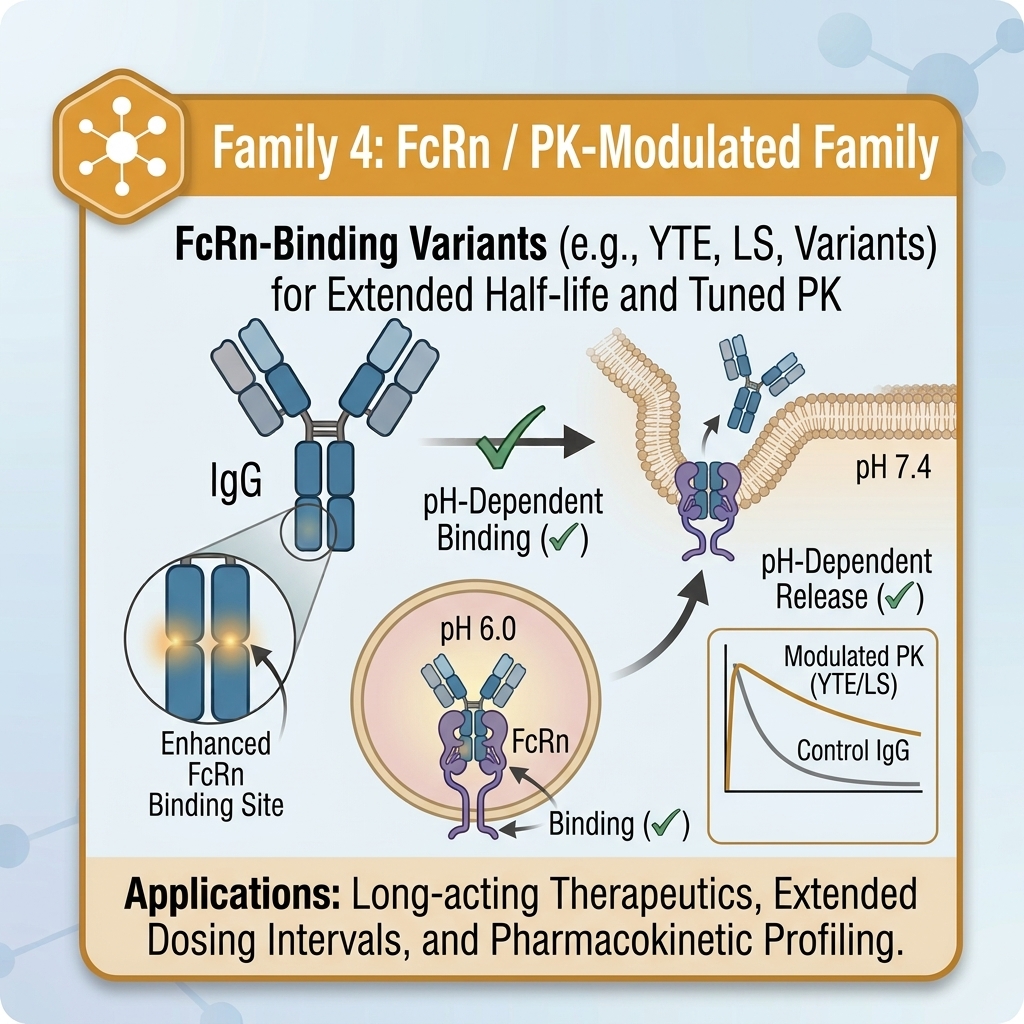
The Human IgG1 (YTE: M252Y/S254T/T256E) Fc variant introduces three coordinated mutations within the CH2 domain designed to enhance FcRn binding at acidic pH and extend serum half-life. Reduced FcγR and C1q interactions also decrease effector function, making YTE ideal for long-acting, low-effector biologics.
Functional Profile
| Property | Effect |
|---|---|
| FcγR binding | Reduced ↓ |
| ADCC | Reduced ↓ |
| CDC | Reduced ↓ |
| FcRn binding | Increased ↑↑ |
| Serum half-life | Extended ↑↑ |
| PK profile | Long-acting |
Mechanism of Action
The YTE Fc variant introduces three coordinated mutations—M252Y, S254T, and T256E—within the CH2 domain. These mutations increase the affinity of IgG1 for FcRn at acidic pH (≈6.0) while maintaining normal dissociation at physiological pH. This enhances Fc recycling and significantly prolongs serum half-life. Reduced FcγR and C1q interactions also decrease effector function, making YTE ideal for long-acting, low-effector biologics.
Phenotypic Effects
- Strongly increased FcRn binding.
- Extended serum half-life (2–4× depending on species).
- Reduced ADCC and CDC.
- Lower FcγR engagement.
- Maintains structural integrity and antigen binding.
- Ideal for long-acting therapeutic antibodies.
Applications
- Long-acting therapeutic antibodies.
- FcRn mechanistic studies.
- PK/PD optimization.
- Antibodies requiring reduced effector function.
- Preclinical development of extended-duration biologics.
Plasmid Map & Feature Annotation
Insert Structure: VH – CH1 – hinge – CH2(M252Y/S254T/T256E) – CH3
- VH: Variable heavy domain
- CH1: Constant heavy 1
- Hinge: Native IgG1 hinge
- CH2(M252Y/S254T/T256E): FcRn-enhancing mutations
- CH3: Constant heavy 3
Fusion BioLabs FcRn / PK-Modulated Family Comparison Matrix
| Variant | Mechanism | Strength (PK Extension) | Primary Application & Notes |
|---|---|---|---|
| human IgG1 (WT) Wild-Type |
Native FcRn binding | ★★☆☆☆ | Baseline Control. Standard physiological baseline (~21-day half-life in humans). |
| human IgG1 (N434A) N434A |
Single-point FcRn-enhanced | ★★★☆☆ | Single-point mutation providing a moderate 1.5–2× PK boost with low immunogenicity risk and easy manufacturing integration. |
| human IgG1 (LA) M428L / N434A |
FcRn-enhanced | ★★★★☆ | Strong PK Extension. Dual mutation combining M428L and N434A; enhances acidic FcRn binding with minimal neutral binding. |
| human IgG1 (LS) M428L / N434S |
FcRn-enhanced | ★★★★★ | Very Strong PK Extension. Extends human serum half-life up to 3–5× (>70–90 days; e.g., tixagevimab / cilgavimab). |
| human IgG1 (YTE) M252Y / S254T / T256E |
FcRn-enhanced | ★★★★★ | This Product. Benchmark PK Extension. Industry-standard benchmark delivering ~3–4× PK boost in humans (e.g., nirsevimab / Beyfortus®). |
| human IgG1 (QL) T250Q / M428L |
FcRn-enhanced | ★★★★☆ | Moderate-to-Strong PK Extension. Increases acidic FcRn affinity with favorable intellectual property freedom to operate. |
| human IgG1 (YTE + KF) M252Y/S254T/T256E + H433K/N434F |
Hyper-FcRn-enhanced / FcRn Blocker | ★★★★★ | FcRn Antagonist / Autoimmune Control. Binds tightly across pH 6.0 and 7.4 to block FcRn recycling and clear endogenous IgGs. |
| human IgG1 (V308P) V308P |
Controlled/Accelerated Clearance | ★★☆☆☆ | Tunable Fast-Clearance Variant. Modulates FcRn dissociation kinetics to yield accelerated clearance (2–5-day half-life); ideal for ADCs and immuno-PET imaging to limit non-target toxicity. |
| human IgG1 (I253A) I253A |
FcRn-null / Abrogated | ★☆☆☆☆ | Ultra-Fast Clearance Control. Complete knockout of the core FcRn binding triad; rapidly cleared within hours. |
Storage & Handling
- Store plasmid at −20°C.
- Avoid repeated freeze–thaw cycles.
- Use sterile technique when handling.
- Suitable for transient or stable mammalian expression.
References
- Dall’Acqua WF, Kiener PA, Wu H. Properties of human IgG1s engineered for enhanced binding to the neonatal Fc receptor (FcRn). J Biol Chem. 2006;281(33):23514-23524.