Plasmid Name
pMC-IgG2a-LALA-PG(L234A/L235A/P329G)
Mutation Set
L234A + L235A + P329G
Selection Marker
Ampicillin
Promoter
CMV
Fc Engineering Overview
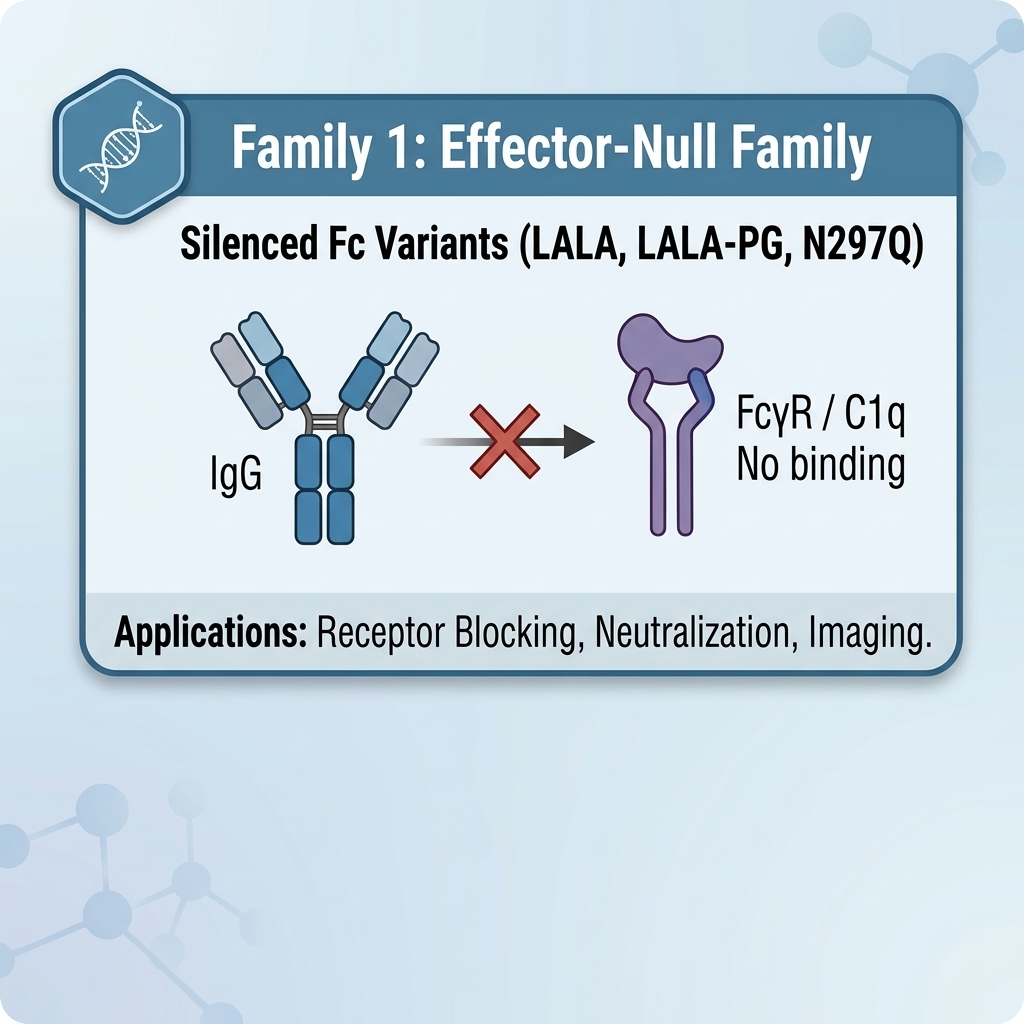
The mouse IgG2a (LALA-PG) Fc variant is a next-generation sequence-silenced murine Fc vector designed to completely eliminate binding to all mouse Fcγ receptors (FcγRI, IIb, III, IV) and murine complement C1q. Serves as the primary double-silent surrogate vector for syngeneic mouse model studies, providing direct translational equivalence to human IgG1 (LALA-PG).
Functional Profile
| Property | Effect |
|---|---|
| Mouse FcγRI/IIb/III/IV binding | Completely Abolished / Undetectable ↓↓↓↓ |
| ADCC (Murine NK / Granulocyte) | Completely Abolished ↓↓↓↓ |
| ADCP (Murine Macrophage) | Completely Abolished ↓↓↓↓ |
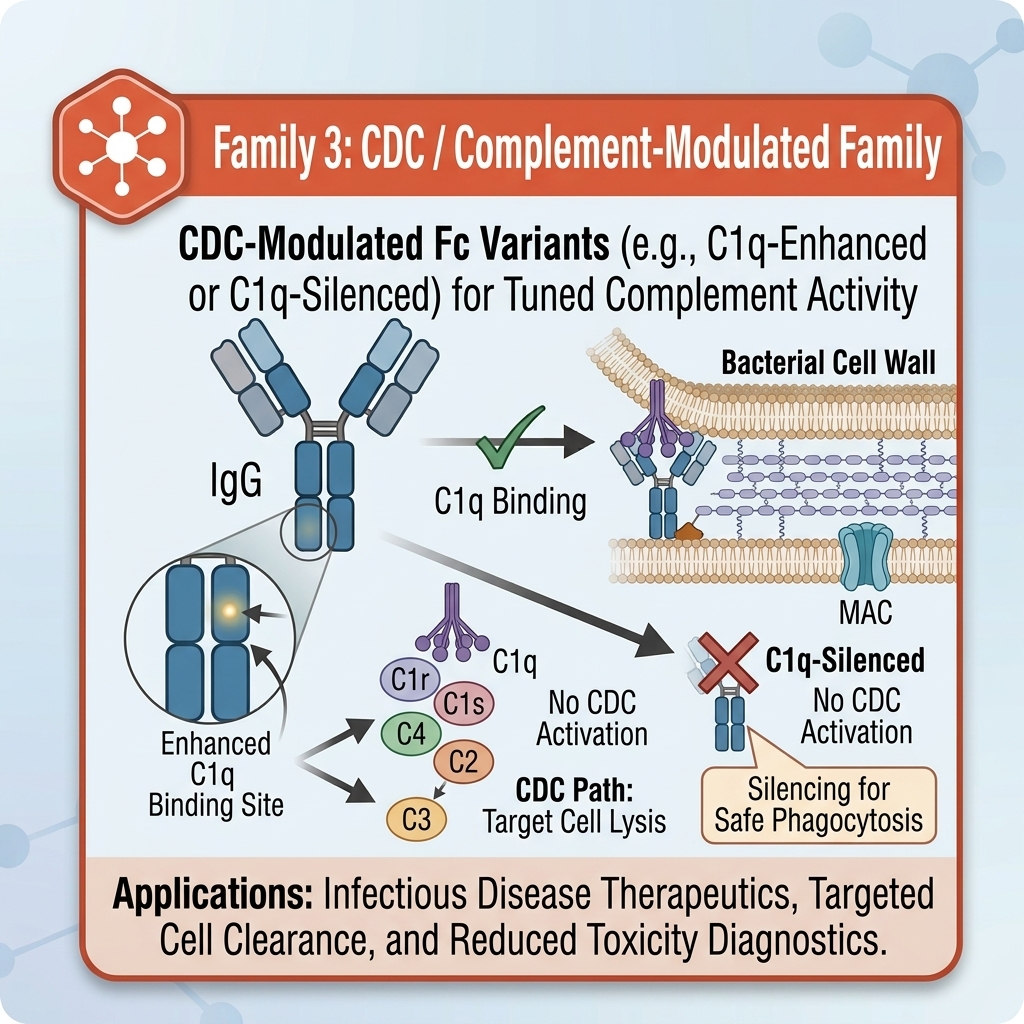
| Mouse C1q binding | Completely Abolished ↓↓↓↓ |
| CDC (Murine Complement) | Completely Abolished ↓↓↓↓ |
| mFcRn binding & half-life | Normal / WT Baseline |
| Glycosylation & Stability | Intact (N297 glycan retained; native thermal stability Tm) |
Mechanism of Action
The mouse IgG2a (LALA-PG) variant utilizes the “proline sandwich” engineering strategy across the lower hinge and CH2 domain:
- L234A / L235A (Lower Hinge): Double alanine substitution in the lower hinge region disrupts the primary hydrophobic and ionic interaction surfaces required for binding to mouse FcγRI, FcγRIIb, FcγRIII, and FcγRIV.
- P329G (CH2 Domain): Proline-to-glycine substitution disrupts the conserved hydrophobic sandwich formed with W381 and W382 of FcγR extracellular domains, while simultaneously abolishing C1q globular head binding.
- Synergistic Silencing: Together, these three mutations eliminate both cellular receptor activation and classical complement fixation in mice while keeping the N-linked glycan at position 297 intact.
Phenotypic Effects
- Total ablation of antibody-dependent cellular cytotoxicity (ADCC) and antibody-dependent cellular phagocytosis (ADCP) in mouse immune systems.
- Prevents target cell depletion, immune complex-mediated platelet activation, and cytokine release syndrome (CRS) in rodent models.
- Maintains standard murine FcRn endosomal recycling and normal in vivo serum pharmacokinetics.
- Preserves physiological glycosylation and biophysical stability without risking the structural destabilization associated with aglycosylated variants (N297Q).
Applications
- Syngeneic mouse model studies evaluating receptor agonists or blocking antibodies where effector functions cause target cell depletion or toxicity.
- In vivo surrogate antibody generation translating human IgG1 (LALA-PG) candidates into mouse-derived models.
- Neutralizing cytokine or checkpoint receptor blocking antibodies (e.g., anti-PD-1, anti-CTLA-4, anti-CD40) requiring zero Fc receptor cross-linking.
- In vivo negative control antibody construction for murine target validation.
Plasmid Map & Feature Annotation
Insert Structure: VH – CH1 – hinge – lower hinge(L234A/L235A) – CH2(P329G) – CH3(wild-type)
- VH: Variable heavy domain
- CH1: Constant heavy 1
- Hinge: Native mouse IgG2a core hinge
- Lower Hinge (L234A/L235A): Mouse lower hinge FcγR-silencing mutations
- CH2 (P329G): CH2 domain proline-sandwich mutation (abolishes C1q and residual FcγR binding)
- CH3 (WT): Native mouse IgG2a CH3 domain
Product Note: Mouse IgG2a is the functional mouse counterpart to human IgG1 in terms of high effector activity. The mouse IgG2a (LALA-PG) vector is essential for preclinical rodent studies where complete effector silencing is required. Unlike legacy single/double mutants or aglycosylated variants, LALA-PG provides zero detectable binding to mouse FcγRIV and C1q while retaining wild-type thermal stability and expression yields.
Fusion BioLabs EffectorNull Family Comparison Matrix
| Variant | Mechanism | Silencing Strength | Notes |
|---|---|---|---|
| human IgG1 (WT) | Wild-Type baseline | Baseline | Human WT Control. Native FcγR and C1q binding; fully active baseline control. |
| mouse IgG2a (WT) | Wild-Type baseline | Baseline | Murine WT Control. Native mouse FcγR and complement binding; active control for syngeneic models. |
| human IgG1 (EN / Armour) E233P / L234V / L235A / ΔG236 + A327G / A330S / P331S |
Lower hinge & CH2 chimeric sequence substitution | ★★★★★ | Ultra-Silent Chimeric Null. Cross-subclass IgG2/IgG4 sequence replacement; abolishes FcγR & CDC engagement. |
| human IgG1 (LALA-PG) L234A / L235A / P329G |
Lower hinge & CH2 proline-sandwich null | ★★★★★ | Clinical Gold Standard. Complete, double-silent suppression of all human FcγRs and C1q/CDC. |
| mouse IgG2a (LALA-PG) L234A / L235A / P329G |
Murine lower hinge & CH2 proline-sandwich | ★★★★★ | This Product. In Vivo Murine Gold Standard. Complete silencing of murine FcγRs and complement in syngeneic mouse models. |
| human IgG1 (LALA) L234A / L235A |
Lower hinge double alanine substitution | ★★★☆☆ | Classic Benchmark Control. Widely used legacy variant; retains minor residual FcγRI (CD64) binding. |
| human IgG1 (ΔG236) ΔG236 |
Lower hinge single residue deletion | ★★★☆☆ | Selective FcγR-Null. Dislocates FcγR binding site while preserving native N-glycan structure and C1q loops. |
| human IgG1 (N297Q) N297Q |
CH2 domain N-glycan site elimination | ★★★★☆ | Human Aglycosylated Control. Broad effector silencing via glycan removal; lowers thermal stability (Tm). |
| mouse IgG2a (N297Q) N297Q |
Murine CH2 domain N-glycan site elimination | ★★★★☆ | Murine Aglycosylated Control. Aglycosylated mouse control for in vivo preclinical rodent studies. |
Storage & Handling
- Store plasmid at −20°C.
- Avoid repeated freeze–thaw cycles.
- Handle using sterile technique.
- Suitable for transient or stable mammalian expression (CHO, HEK293, NS0).
References
- Schlothauer T, Herter S, Koller CF, Grau-Richards S, Steinhart V, Spick C, Kubbies M, Klein C, Umaña P, Mössner E. Novel human IgG1 and IgG4 Fc-engineered antibodies with completely abolished immune effector functions. Protein Eng Des Sel. 2016;29(10):457-466.
- Lo M, Kim HS, Tong RK, Bainbridge TW, Vernes JM, Zhang Y, Lin YL, Chung S, Dennis MS, Zuchero YJ, Watts RJ, Couch JA, Meng YG, Atwal JK, Brezski RJ, Spiess C, Ernst JA. Effector-attenuating Substitutions That Maintain Antibody Stability and Reduce Toxicity in Mice. J Biol Chem. 2017;292(9):3900-3908.