
Plasmid Name
pHC-IgG1-LALAPG
Mutation Set
L234A + L235A + P329G
Selection Marker
Ampicillin
Promoter
CMV
Fc Engineering Overview
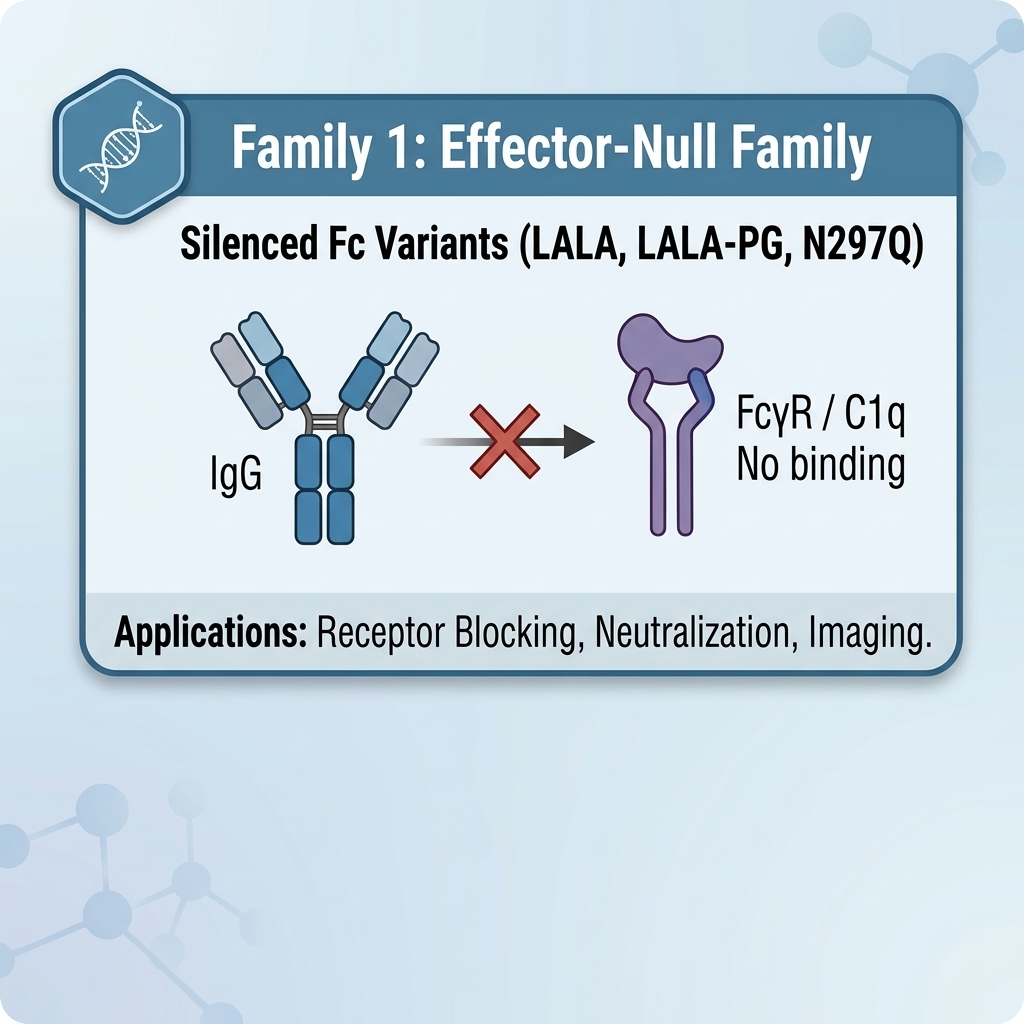
The human IgG1 (LALAPG) Fc variant combines two lower hinge mutations (L234A/L235A) with a CH2 domain mutation (P329G) to completely eliminate all Fcγ receptor binding (FcγRI, IIa, IIb, IIIa) and complement C1q activation, while preserving native FcRn interaction, structural stability, and normal IgG1 pharmacokinetics. It is widely recognized as the clinical gold-standard effector-null Fc backbone in therapeutic antibody development.
Functional Profile
| Property | Effect |
|---|---|
| FcγRI/IIa/IIb/IIIa binding | Completely Abolished / Undetectable ↓↓↓↓ |
| ADCC | Completely Abolished ↓↓↓↓ |
| ADCP (Macrophage Phagocytosis) | Completely Abolished ↓↓↓↓ |
| C1q binding | Completely Abolished ↓↓↓↓ |
| CDC | Completely Abolished ↓↓↓↓ |
| FcRn binding & half-life | Normal / WT Baseline |
| Glycosylation & Thermal Stability | Intact (N297 glycan retained; native CH2 stability Tm ≈ 70°C) |
Mechanism of Action
- L234A/L235A (Lower Hinge): Double alanine substitution in the lower hinge region disrupts the primary hydrophobic backbone interface required for FcγR engagement, severely diminishing binding across all receptor classes.
- P329G (CH2 Domain): Mutating Proline 329 to Glycine breaks the conserved “proline sandwich” formed between Fc and tryptophan residues (W381/W382) on FcγRs, while concurrently destabilizing the core C1q binding loop.
- Combined Effect: Complete effector silencing (FcγR-null + C1q-null). Eliminates residual FcγRI (CD64) binding observed in legacy LALA double mutants while maintaining full endosomal FcRn recycling and native N-glycosylation.
Applications
- Immune checkpoint inhibitors (PD-1, PD-L1, TIGIT, CTLA-4) requiring non-depleting receptor blockade.
- Agonist antibodies requiring target engagement without Fc-mediated receptor cross-linking or platelet activation.
- Multispecific and bispecific antibody constructs requiring zero Fc-mediated toxicity.
- Safety-optimized therapeutic antibodies targeting immune cell populations.
- Primary clinical-grade reference control for effector-null assays.
Plasmid Map & Feature Annotation
Insert Structure: VH – CH1 – hinge – lower hinge(L234A/L235A) – CH2(P329G) – CH3(wild-type)
- VH: Variable heavy domain
- CH1: Constant heavy 1
- Hinge: Native IgG1 core hinge
- Lower Hinge (L234A/L235A): Lower hinge alanine substitutions
- CH2 (P329G): CH2 domain proline-sandwich mutation (abolishes C1q and residual FcγR binding)
- CH3 (WT): Native IgG1 CH3 domain (contains N297 glycan in CH2)
Product Note: LALA-PG is considered the premier industry-standard effector-null Fc backbone. By incorporating P329G into the classic LALA framework, it achieves total immunogenic and functional silencing while retaining native N-glycosylation (N297) and high biophysical stability (Tm ≈ 70°C).
EffectorNull Family Comparison Matrix
| Variant | Mechanism | Silencing Strength | Notes |
|---|---|---|---|
| human IgG1 (WT) | Wild-Type baseline | Baseline | Human WT Control. Native FcγR and C1q binding; fully active baseline control. |
| human IgG1 (EN) | Lower hinge & CH2 chimeric sequence substitution | ★★★★★ | Ultra-Silent Chimeric Null. Cross-subclass IgG2/IgG4 sequence replacement; abolishes FcγR & CDC engagement. |
| human IgG1 (LALA-PG) | Lower hinge & CH2 proline-sandwich null | ★★★★★ | This Product. Clinical Gold Standard. Complete, double-silent suppression of all human FcγRs and C1q/CDC. |
| mouse IgG2a (LALA-PG) | Murine lower hinge & CH2 proline-sandwich | ★★★★★ | In Vivo Murine Gold Standard. Complete silencing of murine FcγRs and complement in syngeneic mouse models. |
| human IgG1 (LALA) | Lower hinge double alanine substitution | ★★★☆☆ | Classic Benchmark Control. Widely used legacy variant; retains minor residual FcγRI (CD64) binding. |
| human IgG1 (ΔG236) | Lower hinge single residue deletion | ★★★☆☆ | Selective FcγR-Null. Dislocates FcγR binding site while preserving native N-glycan structure and C1q loops. |
| human IgG1 (N297Q) | CH2 domain N-glycan site elimination | ★★★★☆ | Human Aglycosylated Control. Broad effector silencing via glycan removal; lowers thermal stability (Tm). |
| mouse IgG2a (N297Q) | Murine CH2 domain N-glycan site elimination | ★★★★☆ | Murine Aglycosylated Control. Aglycosylated mouse control for in vivo preclinical rodent studies. |
Storage & Handling
- Plasmid: Store at −20°C
- Purified Antibody: Store at 2–8°C for short-term; −80°C for long-term. Avoid repeated freeze–thaw cycles.
- Use sterile technique for all handling.
References
- Schlothauer T, Herter S, Koller CF, et al. Novel human IgG1 and IgG4 Fc-engineered antibodies with completely abolished immune effector functions. Protein Eng. Des. Sel. 2016;29:457–466.
- Lo M, Kim HS, Tong RK, et al. Effector-attenuating Substitutions That Maintain Antibody Stability and Reduce Toxicity in Mice. J Biol Chem. 2017;292(9):3900-3908.