PRODUCT OVERVIEW
The Fusion BioLabs Ready-to-Use Z-domain Engineered Protein Scaffold Phage Display Library Kit (AFF-01) provides a highly diverse engineered protein scaffold repertoire for phage display-based binder discovery and screening.
The Z-domain scaffold is a small, engineered protein derived from the B domain of Staphylococcus aureus protein A. It represents an alternative binding scaffold to conventional antibody fragments and provides a compact protein framework for generating target-binding molecules.
The library has a reported diversity of 4.8 × 10¹¹ and was constructed through saturation mutagenesis of 13 defined amino acid positions within the Z-domain scaffold.
The following positions were diversified (VDNKFNKEXXXAXXEIXXLPNLNXXQXXAFIXSLXDDPSQSANLLAEAKKLNDAQAPK)
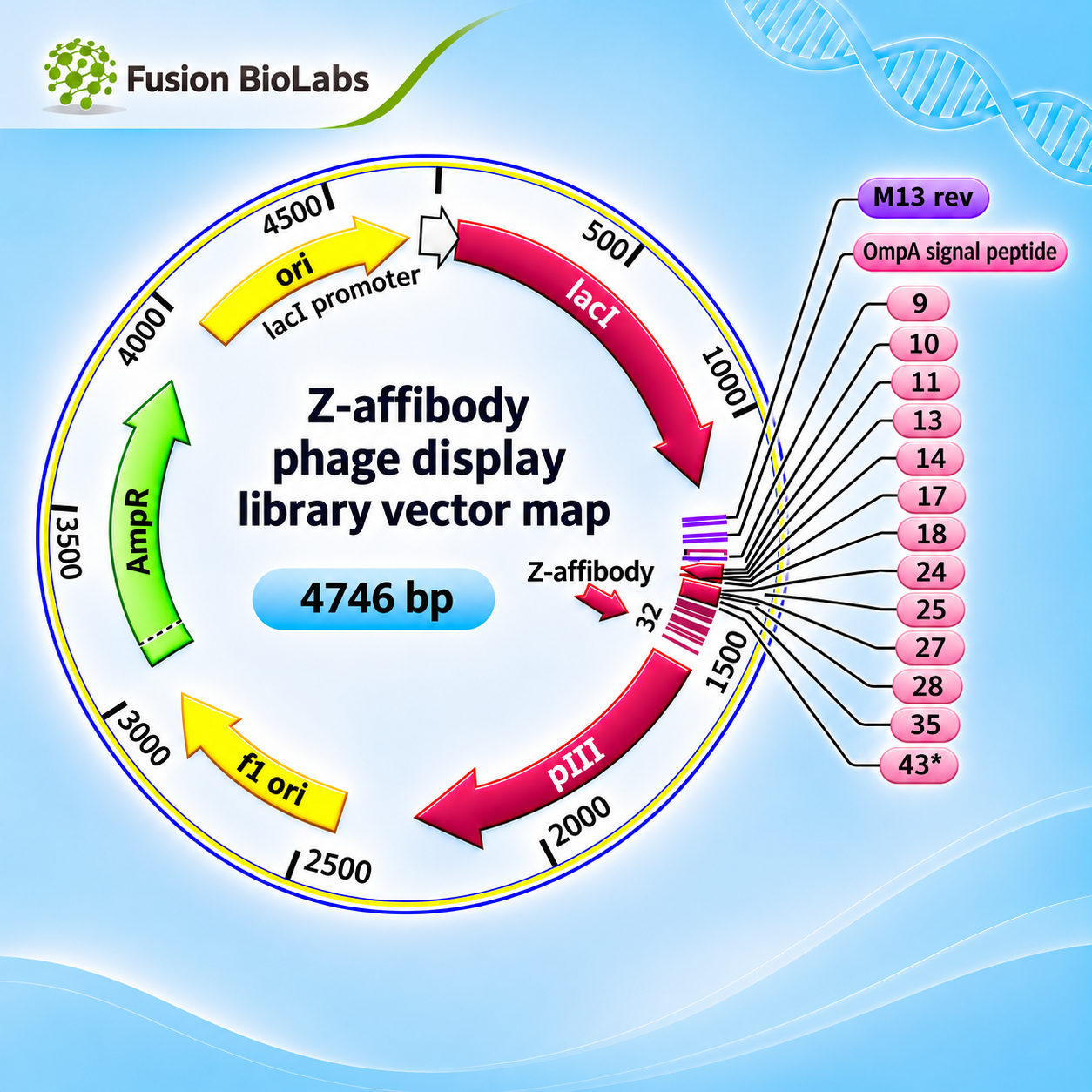
9, 10, 11, 13, 14, 17, 18, 24, 25, 27, 28, 32, and 35.
The phage display construct incorporates the following architecture:
- Display Construct: OmpA leader sequence–engineered Z-domain scaffold–amber stop codon–engineered pIII
- Scaffold Format: Z-domain-based engineered binding protein
- Diversity Strategy: Saturation mutagenesis at 13 selected amino acid positions
- Expression Vector: Engineered phage display vector, 4,746 bp
Library diversity and in-frame sequence representation were assessed using next-generation sequencing (NGS).
The kit provides a ready-to-panning Z-domain scaffold protein phage library together with supporting reagents for protein binder discovery research.
KEY FEATURES
- High Library Diversity: 4.8 × 10¹¹
- Alternative Protein Scaffold: Engineered Z-domain derived from the B domain of staphylococcal protein A
- Defined Scaffold Diversification: Saturation mutagenesis at 13 amino acid positions
- Compact Binding Framework: Small engineered protein scaffold suitable for generating diversified target-binding repertoires
- Phage Display Format: Engineered Z-domain scaffold presented through a pIII-based phage display architecture
- NGS Quality Assessment: Library diversity and in-frame sequence representation assessed by next-generation sequencing
- High Library Phage Titer: 9.2 × 10¹² pfu/mL
- Ready-to-Panning Format: Prepared phage display library supplied with helper phage, competent bacterial host cells, and primer
SCAFFOLD LIBRARY DESIGN AND VECTOR ARCHITECTURE
The AFF-01 library utilizes a Z-domain protein scaffold engineered through saturation mutagenesis of selected residues to generate binding-surface diversity.
Scaffold Diversification
The library incorporates randomized amino acid residues at 13 positions:
| Design Feature | Specification |
|---|---|
| Scaffold origin | B domain of staphylococcal protein A |
| Scaffold format | Engineered Z-domain protein |
| Diversification strategy | Saturation mutagenesis |
| Randomized positions | 9, 10, 11, 13, 14, 17, 18, 24, 25, 27, 28, 32, 35 |
| Library diversity | 4.8 × 10¹¹ |
| Quality assessment | NGS evaluation of diversity and in-frame sequences |
This design generates a library of Z-domain scaffold variants for selection against research targets.
Expression Vector Architecture
The library is constructed in an engineered 4,746-bp phage display vector.
The annotated vector contains the following principal elements:
- lacI regulatory region
- M13 reverse primer-binding site
- OmpA leader sequence
- Engineered Z-domain scaffold coding region
- Amber stop codon
- Engineered pIII coding region
- f1 origin of replication
- Ampicillin resistance gene
- pUC origin of replication
The OmpA leader sequence directs the expressed protein toward the bacterial secretion pathway, while the engineered pIII fusion provides the phage display architecture.
APPLICATIONS
The Z-domain Engineered Protein Scaffold Phage Display Library Kit is intended for research applications involving protein binder discovery, including:
- Alternative Scaffold Binder Discovery: Selection of engineered Z-domain proteins recognizing research targets.
- Phage Display Screening: Biopanning and enrichment of target-binding scaffold variants.
- Protein–Protein Interaction Research: Identification of engineered binding proteins for investigating molecular recognition and protein interactions.
- Protein Binder Engineering: Identification of candidate scaffold binders for subsequent sequence analysis and engineering.
- Affinity and Specificity Characterization: Generation of candidate proteins for downstream experimental evaluation of target binding.
The engineered Z-domain repertoire provides an alternative to conventional antibody-fragment libraries for protein binder discovery.
Binding affinity, specificity, expression performance, and stability require experimental characterization of individual selected candidates.
KIT CONTENTS
The following components are included in the kit.
Ready-to-panning Z-domain-based Scaffold Protein Library Kit Content
| Component | Quantity | Composition |
|---|---|---|
| Z-domain-based scaffold protein library (ready-to-panning phage; 9.2×10¹²pfu/ml) | 1.0 ml | 1×PBS with 25% glycerol |
| M13KO7 Helper Phage (2.0×10¹² pfu/ml) | 0.5 ml | 1×PBS with 25% glycerol |
| Chemically Competent TG1 E. coli (2.5x10⁸cfu/ml) | 0.5 ml | 2xYT with 25% Glycerol |
| M13 Reverse Primer (1.6 µM) | 0.2 ml | 1×TE Buffer |
Component concentrations, buffer formulations, and lot-specific quality specifications should be verified against the current approved product datasheet and Certificate of Analysis.
DOCUMENTATION AND QUALITY CONTROL
Product documentation includes the technical datasheet and annotated phage display vector map.
The library was assessed by next-generation sequencing to evaluate library diversity and in-frame sequence representation.
The technical datasheet identifies the engineered Z-domain scaffold, randomized residue positions, vector architecture, and kit composition.
Additional lot-specific quality control documentation and phage display panning instructions may be provided where available.
For research use only.
Frequently Asked Questions (FAQ)
- Is this an Affibody® library?
No. This is a Z-domain-based scaffold protein library. While it shares a similar structural lineage (the 3-helix bundle derived from Protein A), it uses the original public-domain Z-domain sequence and the classic 13-position randomization map. We are not affiliated with Affibody AB, and our products are not licensed Affibody® molecules.
- What is the difference between this and “optimized” scaffolds?
Proprietary “optimized” scaffolds (such as those used in clinical-stage candidates like izokibep) often contain additional mutations (e.g., at positions 23, 33, or 43) to enhance thermal stability or reduce antibody binding. Our library uses the high-performance original Z-domain backbone (starting with VDNK…). This version is robust, highly stable, and operates under a clear, non-proprietary IP framework.
- Can I use the binders I find for commercial purposes?
Our library is sold for Research Use Only (RUO). While the scaffold itself is based on public-domain sequences, the specific binding sequences you discover against certain medical targets (like HER2, IL-17, or TNFα) may be subject to third-party patents held by other companies. We recommend performing a Freedom to Operate (FTO) search before moving a specific lead into clinical or commercial development.
- Why should I use a Z-domain library instead of an antibody library?
Z-domain scaffolds offer several advantages over traditional IgG libraries:
- Size: At 6.5 kDa, they are 25x smaller than antibodies, allowing for superior tissue penetration.
- Stability: They fold correctly in the cytoplasm (no disulfide bonds needed) and withstand temperatures up to 75°C.
- Production: They are easily expressed at high levels in E. coli, significantly reducing manufacturing costs.
Comparison: Z-Domain Scaffolds vs. Conventional Antibodies (mAbs)
| Feature | Z-Series™ Z-Domain Library | Conventional Antibodies (IgG) |
|---|---|---|
| Molecular Weight | ~6.5 kDa (Ultra-small) | ~150 kDa (Large) |
| Structure | 3-Helix Bundle (58 amino acids) | 4-Chain Complex (Y-shape) |
| Disulfide Bonds | None (Folds in reducing environments) | Required (Complex folding) |
| Tissue Penetration | Excellent (Rapid & Deep) | Poor (Slow diffusion) |
| Thermal Stability | High (Resistant up to 75°C) | Moderate (Sensitive to heat) |
| pH Stability | Broad (pH 2 – 11) | Narrow (Sensitive to acid/base) |
| Production Host | E. coli (Simple & Inexpensive) | Mammalian Cells (Complex & Costly) |
| Blood Clearance | Rapid (Ideal for high-contrast imaging) | Slow (Days to weeks) |
| Immunogenicity | Generally Low | Variable (Depends on "humanization") |
| Engineering Ease | Simple (Single-gene fusion) | Complex (Heavy & Light chains) |
- Why Choose the Z-Domain Library?
- Deep Tissue Imaging: Due to their size (1/25th of an antibody), Z-domain binders can penetrate tumors or dense tissues much faster, providing clearer diagnostic results within hours rather than days.
- Intracellular Applications: Because they do not require disulfide bonds, these proteins fold correctly inside the cytoplasm of living cells—a feat most antibodies cannot achieve.
- Cost-Efficient Scale-Up: Since they are produced in E. coli, the cost per milligram is significantly lower than monoclonal antibodies produced in CHO (Chinese Hamster Ovary) cells.
- Stable Under Stress: They remain functional after exposure to harsh conditions (like those used in chemical conjugation or radiolabeling), where traditional antibodies would denature.
- Is the library compatible with standard phage display protocols?
Yes. Our library is provided in a standard phagemid format (M13 pIII fusion). It is compatible with conventional panning techniques used for ScFv or VHH libraries. We provide a detailed technical protocol with every purchase to ensure a smooth workflow.
- Can these proteins be radiolabeled or conjugated?
Absolutely. The Z-domain scaffold is remarkably resilient to the harsh chemical conditions often required for radiolabeling (for PET/SPECT imaging) or site-specific conjugation to toxins and fluorophores.
Disclaimer for Terms of Sale
INTELLECTUAL PROPERTY AND USE LIMITATIONS
- Nature of Product: This product is a generic Z-domain-based combinatorial protein library derived from the B-domain of Staphylococcal protein A. This product is not an “Affibody®” molecule, and Fusion BioLabs is not affiliated with, endorsed by, or licensed by Affibody AB.
- No Trademark License: The purchase of this library does not grant the buyer any right or license to use the trademark “Affibody®” or any other protected trademarks in connection with the buyer’s research, products, or commercial activities.
- Freedom to Operate (FTO): While the scaffold backbone provided is based on public domain sequences, Fusion BioLabs makes no warranty that the use of this library to identify binders for specific biological targets (e.g., IL-17, HER2, TNFα, etc.) does not infringe upon third-party patents.
- Buyer Responsibility: The Buyer assumes sole responsibility for performing necessary patent searches and obtaining any required licenses for specific therapeutic or diagnostic targets discovered using this library.
- Research Use Only (RUO): This library and its derivatives are intended strictly for in vitro or in vivo laboratory research purposes. They are not approved for human diagnostic or therapeutic use.
- Limitation of Liability: In no event shall Fusion BioLabs be liable for any claims, losses, or damages resulting from the Buyer’s infringement of third-party intellectual property rights arising from the use of the library or the commercialization of molecules derived therefrom.
Reference:
Nord K, Gunneriusson E, Ringdahl J, Ståhl S, Uhlén M, Nygren PA. Binding proteins selected from combinatorial libraries of an alpha-helical bacterial receptor domain. Nat Biotechnol. 1997 Aug;15(8):772-777.