Product Overview
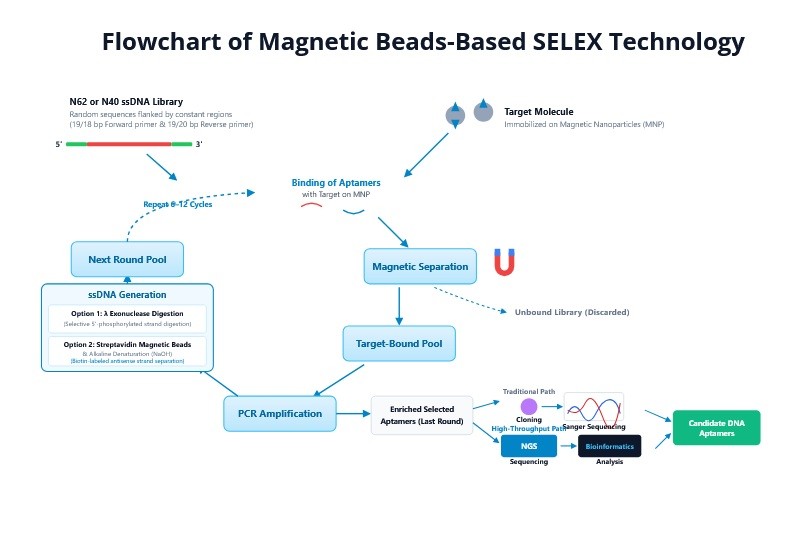
The DAL-02 DNA Aptamer Library Kit is a high-diversity, specialized single-stranded DNA (ssDNA) library pool engineered specifically for Capture-SELEX (Systematic Evolution of Ligands by Exponential Enrichment). Unlike traditional SELEX methods that require target molecule immobilization, the DAL-02 system immobilizes the ssDNA library onto a solid support via a complementary biotinylated capture oligonucleotide, leaving the target molecule entirely unmodified in solution.
This solution-phase target interaction makes DAL-02 the ideal platform for discovering high-affinity aptamers against small molecules, metabolites, lipids, peptides, and sensitive proteins whose native conformations would be disrupted by surface immobilization.
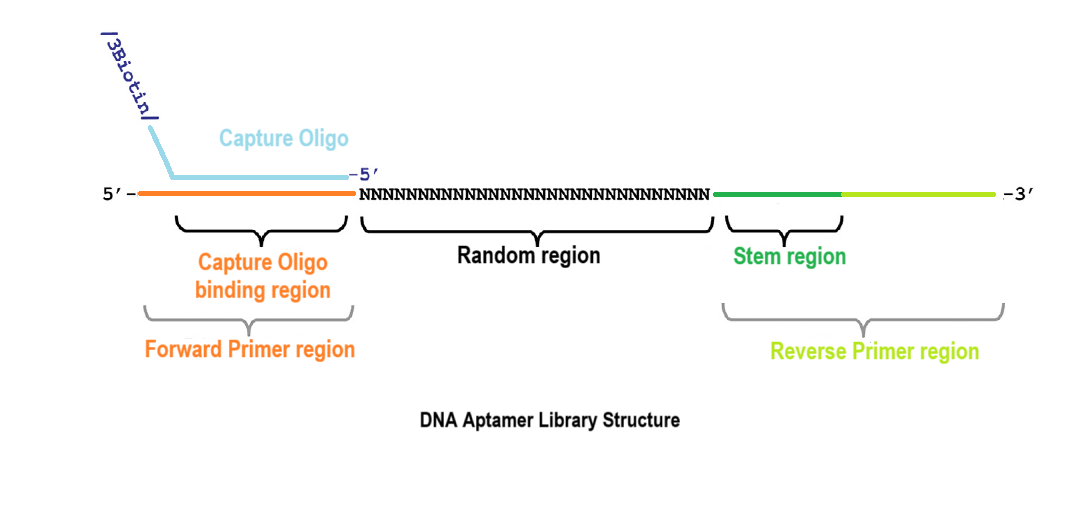
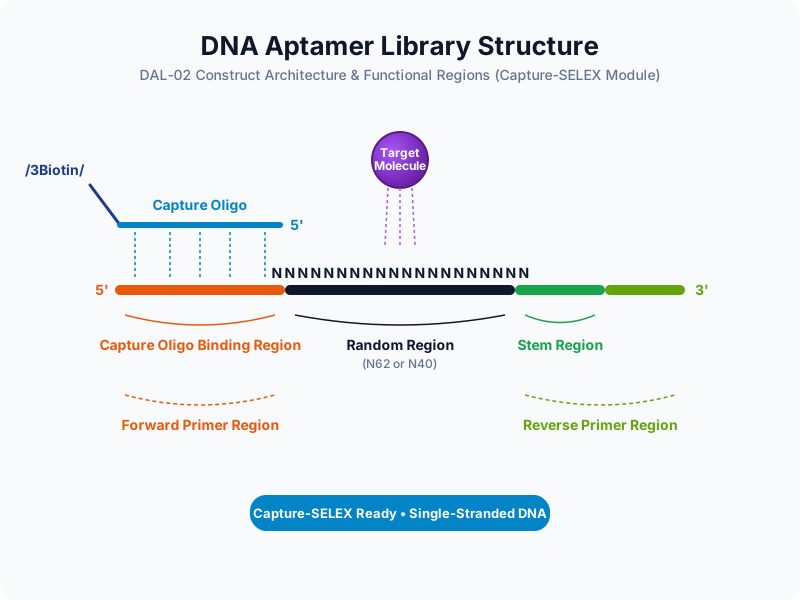
DNA Aptamer Library Structure (DAL-02)
Performance Specifications
- Library Diversity: ~1014 – 1015 unique ssDNA sequences per pool.
- Purity: PAGE-purified / HPLC-purified (>95% full-length product).
- Docking Site Tm: Optimized 10-nt capture region (Tm ~ 42°C-45°C) ensuring stable hybridization during wash steps and efficient release upon target binding.
- Target Compatibility: Small molecules, antibiotics, mycotoxins, peptides, recombinant proteins, and whole cells.
- Downstream Compatibility: High-Throughput Next-Generation Sequencing (Illumina NGS) and Sanger sequencing.
Key Features
- Immobilization-Free Target Selection: Preserves authentic target tertiary structure and active binding sites.
- Pre-Optimized Docking Region: Engineered terminal capture region provides consistent hybridization kinetics without interfering with random loop folding.
- Minimal Primer-Dimer Artifacts: Primer pair sequences designed with low secondary structure potential for clean PCR amplification.
- Dual-Labeled Selection Primers Included: Features 5′-FAM labeled forward primer and 5′-Phosphorylated reverse primer for rapid Fluorometer tracking and Lambda Exonuclease strand separation.
- Complete Ready-to-Use Workflow: Pre-validated reagents allow immediate execution of selection cycles out of the box.
Library Configurations & Specifications
This kit is available with two random region configurations:
| SKU Option | Forward Primer | Random Region | Reverse Primer | Total Length |
|---|---|---|---|---|
| DAL-02 (N62) | 19 bp | N62 (62 nt) | 19 bp | 100 nt |
| DAL-02 (N40) | 18 bp | N40 (40 nt) | 20 bp | 78 nt |
Kit Contents
| Component | Quantity |
|---|---|
| Vial 1: ssDNA Library Oligos | 20 µl, 100 µM |
| Vial 2: 5′-Biotinylated Capture Oligos | 60 µl, 100 µM |
| Vial 3: Forward Primer | 20 µl, 100 µM |
| Vial 4: 5′-FAM Labeled Forward Primer | 20 µl, 100 µM |
| Vial 5: Reverse Primer | 20 µl, 100 µM |
| Vial 6: 5′-Phosphorylated Reverse Primer | 20 µl, 100 µM |
| Vial 7: Streptavidin-Coated Magnetic Beads | 3.0 ml |
| Vial 8: Lambda Exonuclease Reaction Buffer (10X) | 100 µl |
| Vial 9: Lambda Exonuclease (5 units/µl) | 20 µl |
| Vial 10: ssDNA Binding Buffer | 15 ml |
| Vial 11: ssDNA Preparation Buffer | 15 ml |
| Vial 12: ssDNA Wash Buffer | 9.0 ml |
| Vial 13: PCR-grade Water | 1.5 ml |
| Vial 14: 2x PCR Master Mix | 3.0 ml |
| ssDNA Cleanup Column I | 30 columns |
| ssDNA Cleanup Column II | 30 columns |
| Collection Tubes | 60 tubes |
| Nuclease-free Tubes | 30 tubes |
* Store at -20°C; reagents are guaranteed stable for 12 months when properly stored.
Protocol Flowchart & Selection Workflow
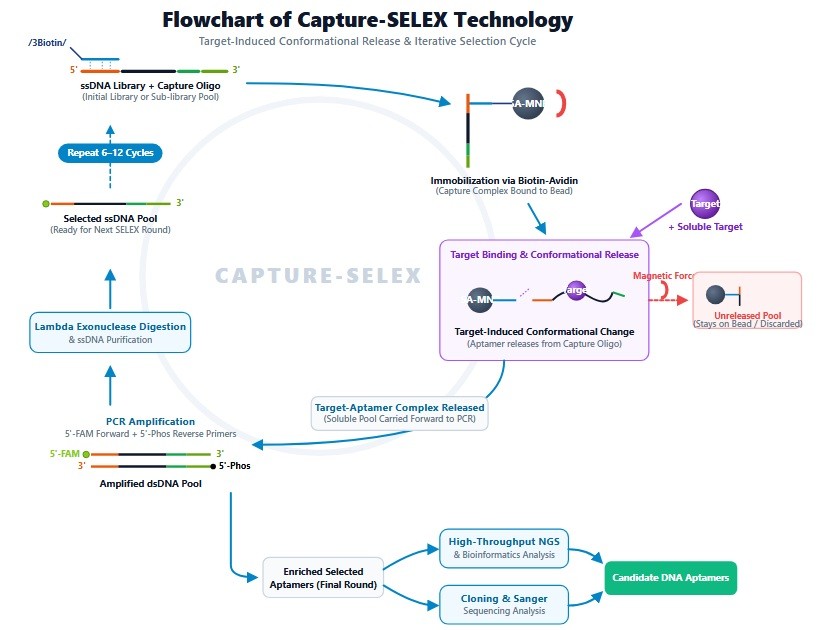
The Capture-SELEX workflow functions through an iterative cycle of hybridization, target-induced release, magnetic separation, PCR amplification, and single-strand generation:

Step-by-Step Selection Workflow
- Library Hybridization & Bead Immobilization: The ssDNA library pool is annealed to the complementary 3′-Biotinylated Capture Oligo. The resulting hybrid complex is bound to Streptavidin Magnetic Nanoparticles (SA-MNPs) via biotin-avidin interaction.
- Soluble Target Incubation & Conformational Release: The immobilized library is incubated with the soluble, non-labeled target molecule. High-affinity aptamer candidates undergo a target-induced conformational change, switching structure to fold around the target and releasing from the capture strand into the supernatant.
- Magnetic Partitioning: A magnetic field is applied to separate the bead-bound non-specific pool from the target-aptamer complex released into solution. The target-released supernatant is collected.
- PCR Amplification: The target-released ssDNA pool is amplified via PCR using 5′-FAM Forward and 5′-Phosphorylated Reverse primers to yield labeled double-stranded DNA (dsDNA).
- Strand Separation: Lambda Exonuclease selectively digests the 5′-Phosphorylated antisense strand, regenerating the functional, fluorescently labeled 5′-FAM ssDNA sub-library for the subsequent SELEX round.
- Iterative Selection & Downstream Analysis: The process is repeated for 6–12 rounds under increasing selection stringency. Enriched pools undergo High-Throughput Next-Generation Sequencing (NGS) or cloning and Sanger sequencing to identify top aptamer candidates.
Applications & Kit Usage
Small Molecule Screening
Ideal for targets that cannot be immobilized on matrix surfaces without loss of binding epitopes (e.g., toxins, antibiotics, neurotransmitters).
Conformational Biosensors
Selection naturally enriches aptamers that undergo significant structural switching, ideal for structure-switching electrochemical or optical biosensors.
Native Protein Recognition
Enables selection against native proteins in physiological buffers without chemical modification or tag conjugation.