Plasmid Name
pHCIgG1DE
Mutation Set
S239D / I332E
Selection Marker
Ampicillin
Promoter
CMV
Fc Engineering Overview
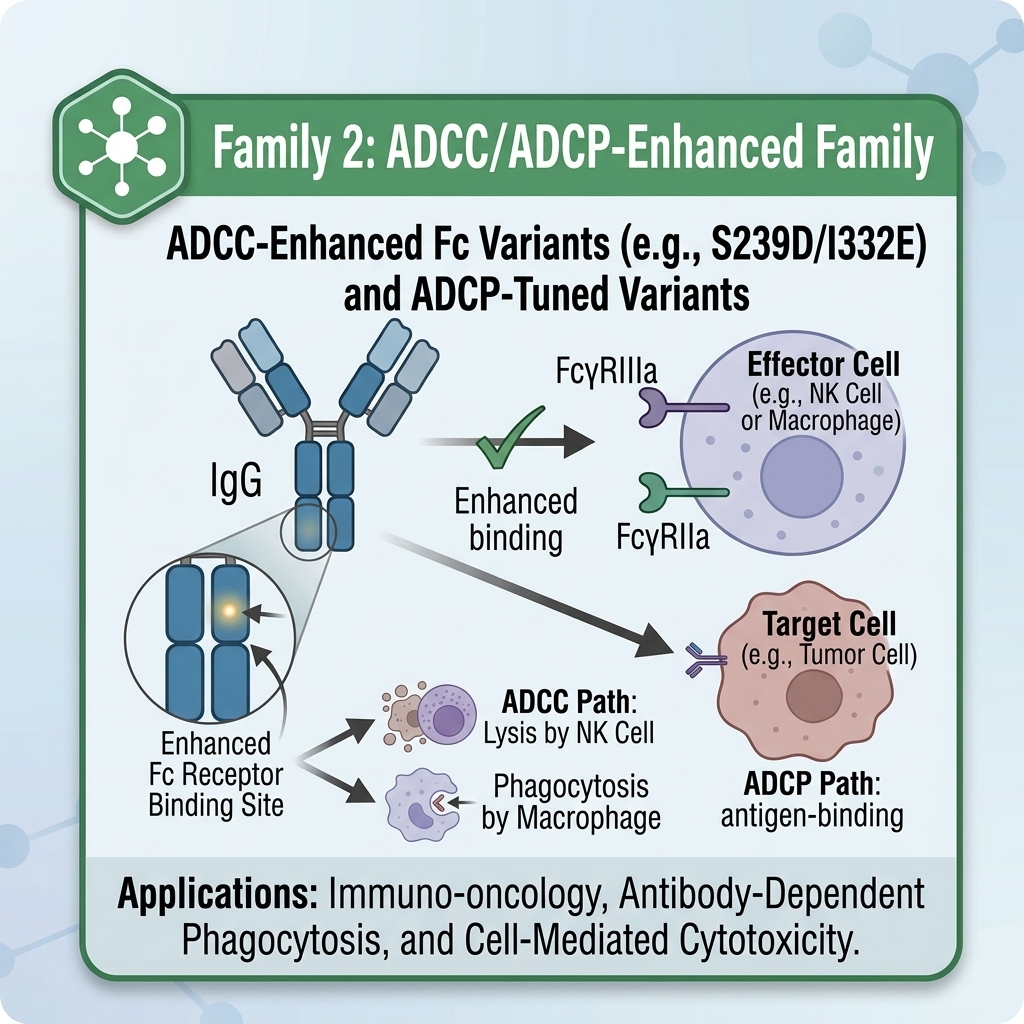
The human IgG1 (DE) Fc variant features a core dual-mutation engineered to optimize electrostatic interactions at the FcγRIIIa and FcγRIIa interfaces. This modification boosts NK cell-mediated ADCC and macrophage-mediated ADCP potency while retaining baseline complement (CDC) activity and standard FcRn-mediated recycling kinetics.
Functional Profile
| Property | Effect |
|---|---|
| FcγRIIIa binding (V158 & F158) | Significantly Increased ↑↑ (∼10–20× affinity boost) |
| FcγRIIa binding | Increased ↑ (Enhanced A/I activation ratio) |
| ADCC | Potently Enhanced ↑↑↑ |
| ADCP | Enhanced ↑↑ |
| CDC | WT Baseline / Neutral |
| FcRn binding & half-life | Normal / WT Baseline |
| Effector Potency | Balanced High-Potency ADCC/ADCP |
Mechanism of Action
The DE Fc variant introduces two synergistic amino acid substitutions in the CH2 domain—Ser239 to Asp and Ile332 to Glu:
- S239D & I332E: Inserting negatively charged aspartate and glutamate residues optimizes electrostatic complementarity with positively charged residues on the extracellular domains of activating receptors, particularly FcγRIIIa (CD16a) and FcγRIIa (CD32a).
This dual substitution substantially enhances receptor binding affinity without perturbing the CH2-CH3 interface responsible for FcRn endosomal recycling or disrupting the complement C1q binding interface.
Phenotypic Effects
- Substantial increase in NK cell recruitment and ADCC killing activity.
- Enhanced binding to both high-affinity (V158) and low-affinity (F158) FcγRIIIa patient allotypes.
- Improved macrophage-mediated phagocytosis (ADCP).
- Retains physiological complement activation (CDC) baseline.
- Preserves standard FcRn-mediated recycling and systemic clearance kinetics.
Applications
- Therapeutic oncology antibodies requiring enhanced NK- and macrophage-mediated target cell depletion.
- Cell-depleting antibody formats against targets with moderate-to-high antigen expression.
- Foundational double-mutation module for comparative effector engineering studies.
- Optimization of therapeutic formats where controlled, non-extreme ADCC enhancement is desired.
Plasmid Map & Feature Annotation
Insert Structure: VH – CH1 – hinge – CH2(S239D/I332E) – CH3(wild-type)
- VH: Variable heavy domain
- CH1: Constant heavy 1
- Hinge: Native IgG1 hinge
- CH2 (S239D/I332E): ADCC/ADCP-enhancing electrostatic double mutation
- CH3 (WT): Native IgG1 CH3 domain
Product Note: The DE variant (S239D/I332E) serves as the core foundational module in the Fusion BioLabs ADCC/ADCP-Enhanced Family. It provides a robust boost in effector function and serves as the structural building block for higher-order variants such as DLE (+A330L) and GASDALIE (+G236A/A330L).
Fusion BioLabs ADCC/ADCP-Enhanced Family Comparison Matrix
| Variant | Mechanism | Enhancement Strength | Primary Application & Notes |
|---|---|---|---|
| human IgG1 (WT) Wild-Type |
Native baseline FcγR binding | ★★☆☆☆ | Baseline Control. Standard physiological FcγR binding and ADCC/ADCP baseline for comparative assays. |
| human IgG1 (G236A) G236A |
Lower hinge FcγRIIa selective optimization | ★★★☆☆+ | Selective ADCP Enhancer. Specifically boosts macrophage phagocytosis by maximizing the FcγRIIa/FcγRIIb activation ratio. |
| human IgG1 (DE) S239D / I332E |
CH2 domain electrostatic interface enhancement | ★★★☆☆ | This Product. Moderate ADCC/ADCP Enhancer. Core double mutation boosting FcγRIIIa and FcγRIIa engagement. |
| human IgG1 (DLE) S239D / A330L / I332E |
CH2 domain structural interface enhancement | ★★★★☆ | Strong ADCC Enhancer. Classic triple mutation optimizing NK cell-mediated lysis. |
| human IgG1 (ADE) G236A / S239D / I332E |
CH2 domain multi-residue FcγRIIIa optimization | ★★★★☆+ | High-Potency ADCC/ADCP Enhancer. Increases FcγRIIIa binding while improving the FcγRIIa/FcγRIIb binding ratio to favor activation over inhibition. |
| human IgG1 (GASDALIE) G236A / S239D / A330L / I332E |
CH2 domain hyper-enhancement (FcγRIIIa & FcγRIIa) | ★★★★★ | Ultra-Potent ADCC/ADCP Enhancer. Maximum engineered affinity variant for low antigen density targets. |
Storage & Handling
- Store plasmid at −20°C.
- Avoid repeated freeze–thaw cycles.
- Use sterile technique when handling.
- Suitable for transient or stable mammalian expression.
References
- Lazar GA, Dang W, Karki S, Vafa O, Peng JS, Hyun L, Chan C, Chung HS, Eivazi A, Yoder SC, Vielmetter J, Carmichael DF, Hayes RJ, Dahiyat BI. Engineered antibody Fc variants with enhanced effector function. Proc Natl Acad Sci U S A. 2006;103(11):4005-4010.