Plasmid Name
pHCIgG1Agly(N297Q)
Mutation Set
N297Q
Selection Marker
Ampicillin
Promoter
CMV
Fc Engineering Overview
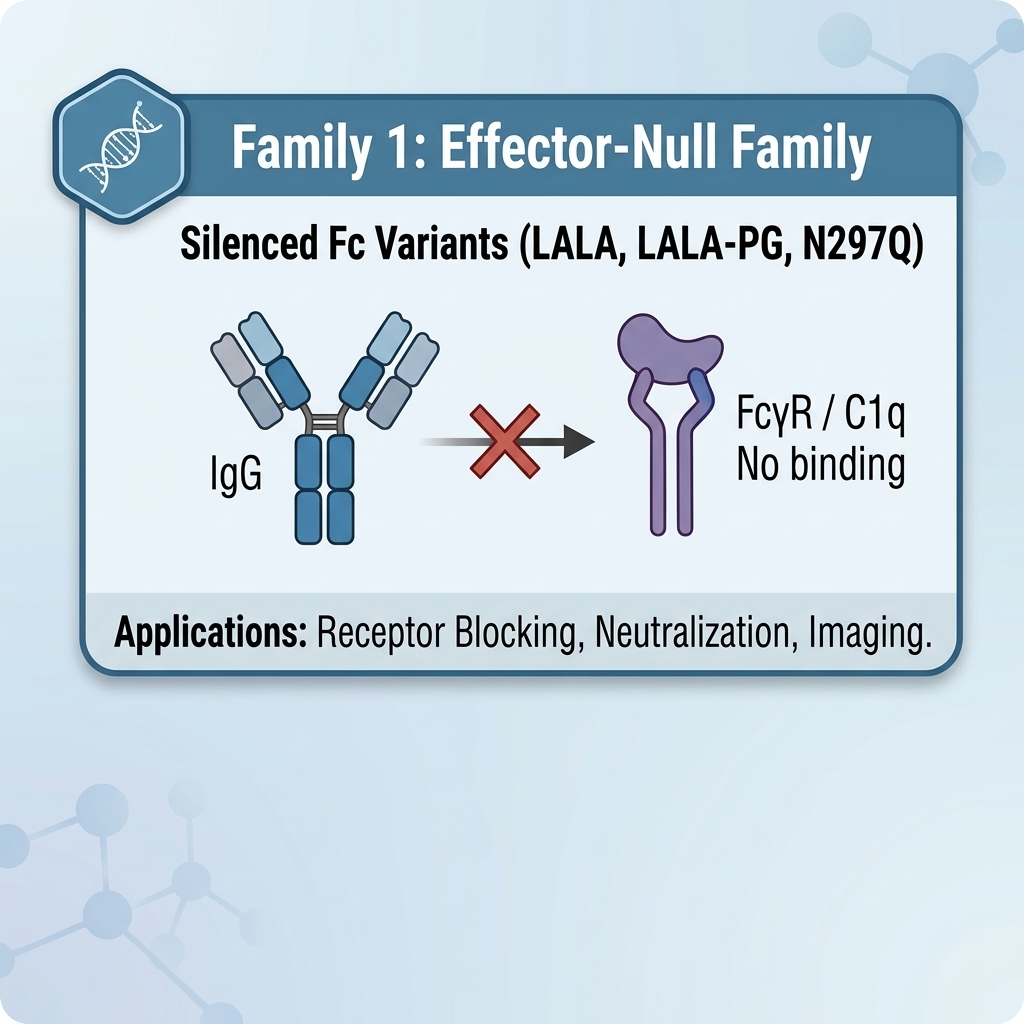
The human IgG1 (N297Q) Fc variant is a primary aglycosylated human Fc vector designed to eliminate the conserved N297 biantennary glycan. Disables FcγR and C1q binding via global conformational collapse of the CH2 domain interface rather than primary sequence substitution.
Functional Profile
| Property | Effect |
|---|---|
| FcγRI/IIa/IIb/IIIa binding | Abolished / Undetectable ↓↓↓↓ |
| ADCC | Completely Abolished ↓↓↓↓ |
| ADCP (Macrophage Phagocytosis) | Completely Abolished ↓↓↓↓ |
| C1q binding | Severely Reduced / Minimal ↓↓↓ |
| CDC | Severely Reduced / Minimal ↓↓↓ |
| FcRn binding & half-life | Normal / WT Baseline |
| Glycosylation & Thermal Stability | Aglycosylated (N297 glycan absent); reduced CH2 thermal stability (Tm ≈ 60°C) |
Mechanism of Action
The N297Q substitution operates through a glycosylation-dependent conformational mechanism within the CH2 domain:
- Glycan Elimination: Replacing Asparagine with Glutamine at EU position 297 removes the consensus Asn-X-Ser/Thr motif, preventing N-linked glycosylation during post-translational processing.
- Conformational Collapse: The conserved N297 glycan acts as an internal molecular strut that maintains the open, rigid conformation of the two CH2 domains. Without this glycan, the CH2 domains collapse inward toward one another, physically closing off the binding sites required for FcγRs and globular C1q heads.
Phenotypic Effects
- Complete elimination of cell-mediated cytotoxicity (ADCC) and macrophage phagocytosis (ADCP).
- Severe attenuation of classical complement pathway activation (CDC).
- Preserves standard FcRn endosomal recycling and systemic serum half-life.
- Produces homogeneous, non-glycosylated antibody preparations in mammalian systems.
- Exhibits reduced CH2 domain thermal stability (Tm drops from ~71°C down to ~60°C).
Applications
- Therapeutic antibody programs targeting cell surface receptors where effector function induces cytotoxicity (e.g., anti-PD-1, anti-PD-L1, anti-TIGIT).
- Agonist antibodies requiring pure target engagement without Fc-mediated receptor cross-linking.
- Expression in expression systems lacking human-like glycosylation pathways.
- Baseline control for comparing sequence-silenced null formats (LALA-PG, EN) against aglycosylated variants.
Plasmid Map & Feature Annotation
Insert Structure: VH – CH1 – hinge(wild-type) – CH2(N297Q) – CH3(wild-type)
- VH: Variable heavy domain
- CH1: Constant heavy 1
- Hinge: Native IgG1 core and lower hinge
- CH2 (N297Q): CH2 domain containing the aglycosylating N297Q substitution
- CH3 (WT): Native IgG1 CH3 domain
Product Note: The N297Q variant remains a benchmark aglycosylated Fc control in therapeutic antibody discovery. While N297Q delivers complete effector silencing, users should note that the absence of the N297 glycan lowers the thermal melting temperature (Tm) of the CH2 domain. For applications requiring maximum biophysical stability, fully glycosylated sequence-silenced variants such as human IgG1 (LALA-PG) or human IgG1 (ΔG236) are recommended.
Fusion BioLabs EffectorNull Family Comparison Matrix
| Variant | Mechanism | Silencing Strength | Notes |
|---|---|---|---|
| human IgG1 (WT) | Wild-Type baseline | Baseline | Human WT Control. Native FcγR and C1q binding; fully active baseline control. |
| mouse IgG2a (WT) | Wild-Type baseline | Baseline | Murine WT Control. Native mouse FcγR and complement binding; active control for syngeneic models. |
| human IgG1 (EN / Armour) E233P / L234V / L235A / ΔG236 + A327G / A330S / P331S |
Lower hinge & CH2 chimeric sequence substitution | ★★★★★ | Ultra-Silent Chimeric Null. Cross-subclass IgG2/IgG4 sequence replacement; abolishes FcγR & CDC engagement. |
| human IgG1 (LALA-PG) L234A / L235A / P329G |
Lower hinge & CH2 proline-sandwich null | ★★★★★ | Clinical Gold Standard. Complete, double-silent suppression of all human FcγRs and C1q/CDC. |
| mouse IgG2a (LALA-PG) L234A / L235A / P329G |
Murine lower hinge & CH2 proline-sandwich | ★★★★★ | In Vivo Murine Gold Standard. Complete silencing of murine FcγRs and complement in syngeneic mouse models. |
| human IgG1 (LALA) L234A / L235A |
Lower hinge double alanine substitution | ★★★☆☆ | Classic Benchmark Control. Widely used legacy variant; retains minor residual FcγRI (CD64) binding. |
| human IgG1 (ΔG236) ΔG236 |
Lower hinge single residue deletion | ★★★☆☆ | Selective FcγR-Null. Dislocates FcγR binding site while preserving native N-glycan structure and C1q loops. |
| human IgG1 (N297Q) N297Q |
CH2 domain N-glycan site elimination | ★★★★☆ | This Product. Human Aglycosylated Control. Broad effector silencing via glycan removal; lowers thermal stability (Tm). |
| mouse IgG2a (N297Q) N297Q |
Murine CH2 domain N-glycan site elimination | ★★★★☆ | Murine Aglycosylated Control. Aglycosylated mouse control for in vivo preclinical rodent studies. |
Storage & Handling
- Plasmid: Store at −20°C.
- Purified Antibody: Store at 2–8°C for short-term storage; −80°C for long-term storage.
- Avoid repeated freeze–thaw cycles.
- Handle using sterile technique.
- Suitable for transient or stable mammalian expression (CHO, HEK293, NS0).
References
- Wright A, Morrison SL. Effect of altered CH2-associated carbohydrate structure on the functional properties and in vivo fate of chimeric mouse-human immunoglobulin G1. J Exp Med. 1994;180(3):1087-1096.
- Radaev S, Sun P. Recognition of immunoglobulins by Fcγ receptors. Mol Immunol. 2002;38(14):1073-1083.
- Sazinsky SL, Ott RG, Silver NW, Tidor B, Ravetch JV, Wittrup KD. Aglycosylated immunoglobulin G1 variants productively engage activating Fc receptors. Proc Natl Acad Sci U S A. 2008;105(51):20167-20172.