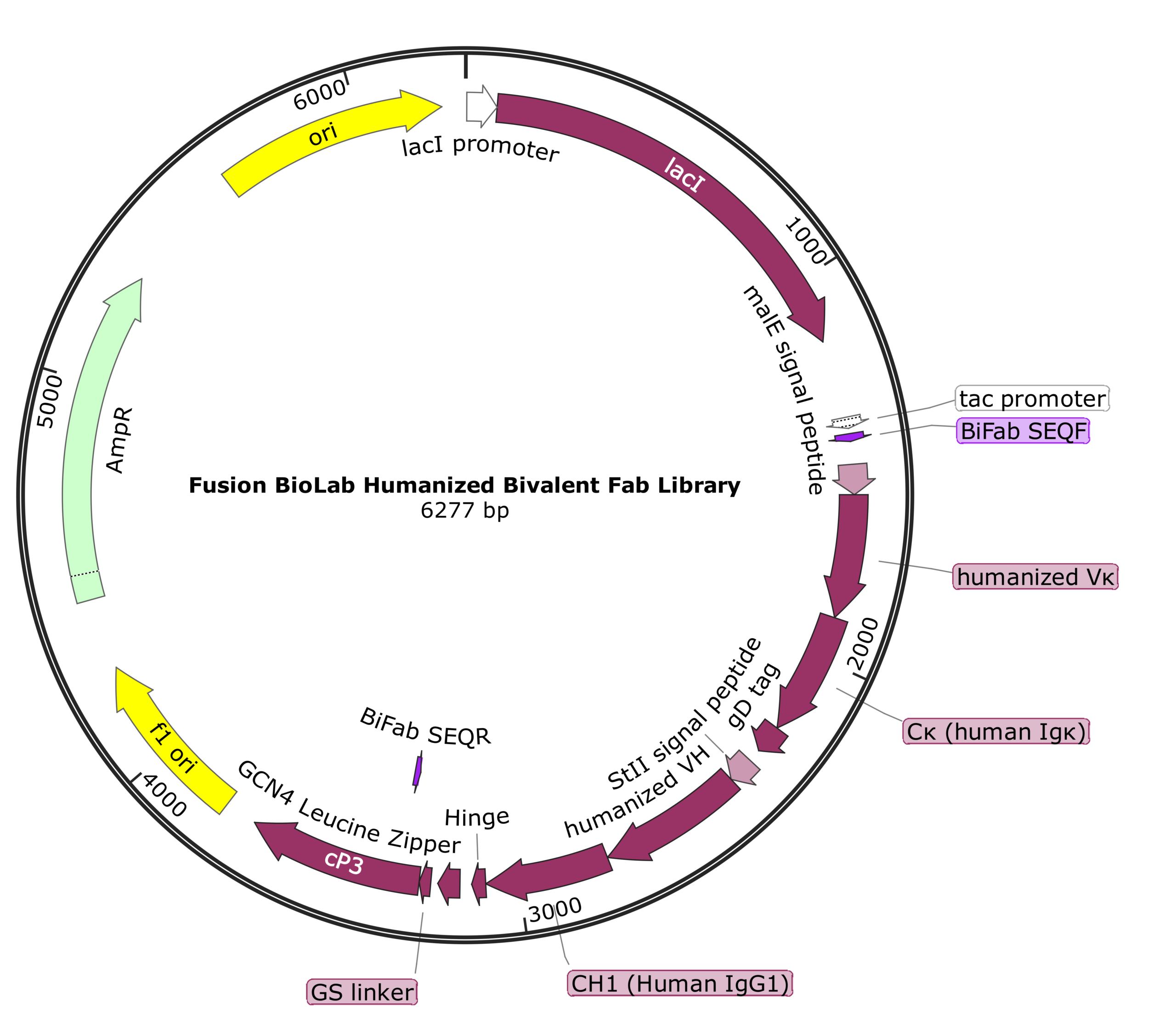
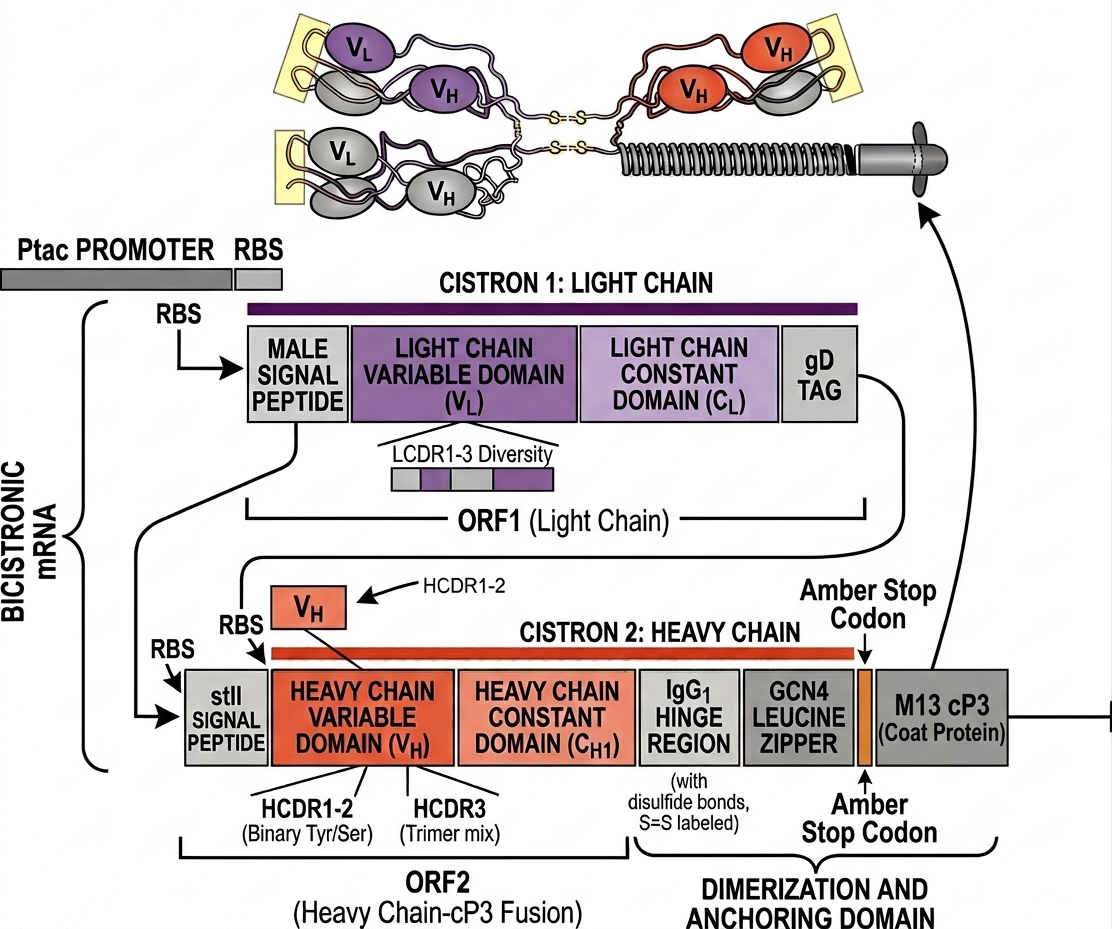
- Format: Fab with malE signal peptide-Vk-Cκ (human Igκ)-gD tag: StII signal peptide-VH-CH1 (human IgG1)- Hinge and GCN4 Leucine Zipper)
- Diversity: 3.4×10¹⁰
- The diversity and in-frame of the library were checked by NGS.
Product Description
The Fusion BioLabs Ready-to-Use Humanized Bivalent Fab Phage Display Library Kit (SKU: ADL-12) is a next-generation antibody discovery platform engineered to bypass the structural and genetic constraints of conventional phage display systems. By combining an ultra-high diversity, synthetic human paratope with a true bivalent structural framework, this kit successfully delivers the high functional performance of a synthetic repertoire alongside the natural avidity advantages of an immunoglobulin molecule.
Conventional monovalent platforms often fail to recover low-to-moderate affinity clones, struggle with cell-surface selections, and introduce severe structural mutations when converting single-chain fragments (scFvs) into full IgGs. Fusion BioLabs resolves these roadblocks by engineering a robust bivalent display cassette—integrating a native human IgG1 hinge region and a homodimerizing GCN4 leucine zipper domain directly into the phagemid coat protein vector. The resulting phage particles actively display two functional Fab arms, mimicking natural IgGs to capture powerful avidity effects, drive exceptionally low off-rates, and selectively enrich for receptor-agonistic or cell-internalizing leads right from the panning stage.
Performance & Selection Advantages
Fusion BioLabs' Humanized Bivalent Fab Performance & Selection Advantages
| Feature | Monovalent Fab / scFv Libraries | Fusion BioLabs Bivalent Fab Kit |
|---|---|---|
| Avidity Benefit | Minimal (Fab) or Uncontrolled Oligomerization (scFv) | Controlled IgG-like Avidity (Low Off-Rates) |
| Cell-Surface Panning | Poor retention of moderate-affinity clones | Enhanced capture & cell internalization |
| Target Flexibility | Stalls on weak or heavily masked epitopes | High recovery on low-density or difficult antigens |
| Biophysical Stability | Variable framework behavior | Optimized human framework baseline |
Kit contents
The following components are included in the kit.
Ready-to-panning Humanized Bivalent Fab Library Kit Content
| Component | Quantity | Composition |
|---|---|---|
| Humanized Bivalent Fab library (ready-to-panning phage; 3.4×10¹²pfu/ml) | 1.0 ml | 1×PBS with 25% glycerol |
| M13KO7 Helper Phage (2.0×10¹² pfu/ml) | 0.5 ml | 1×PBS with 25% glycerol |
| Chemically Competent TG1 E. coli (2.5x10⁸cfu/ml) | 0.5 ml | 2xYT with 25% Glycerol |
| BiFab SEQF Primer | 0.2 ml | 1×TE Buffer |
| BiFab SEQR Primer | 0.2 ml | 1×TE Buffer |
Key Repertoire Features
- Natural IgG Mimicry via True Bivalence: Incorporates a robust dimerization cassette (IgG1 hinge + GCN4 leucine zipper) between the heavy chain and the cP3 coat protein. This displays dual functional Fab arms per phage particle, driving excellent avidity-based capture on complex targets.
- Massive, Ultra-High Diversity: A highly functional synthetic repertoire yielding 3.4 x 10¹⁰ unique transformants to maximize sequence space coverage.
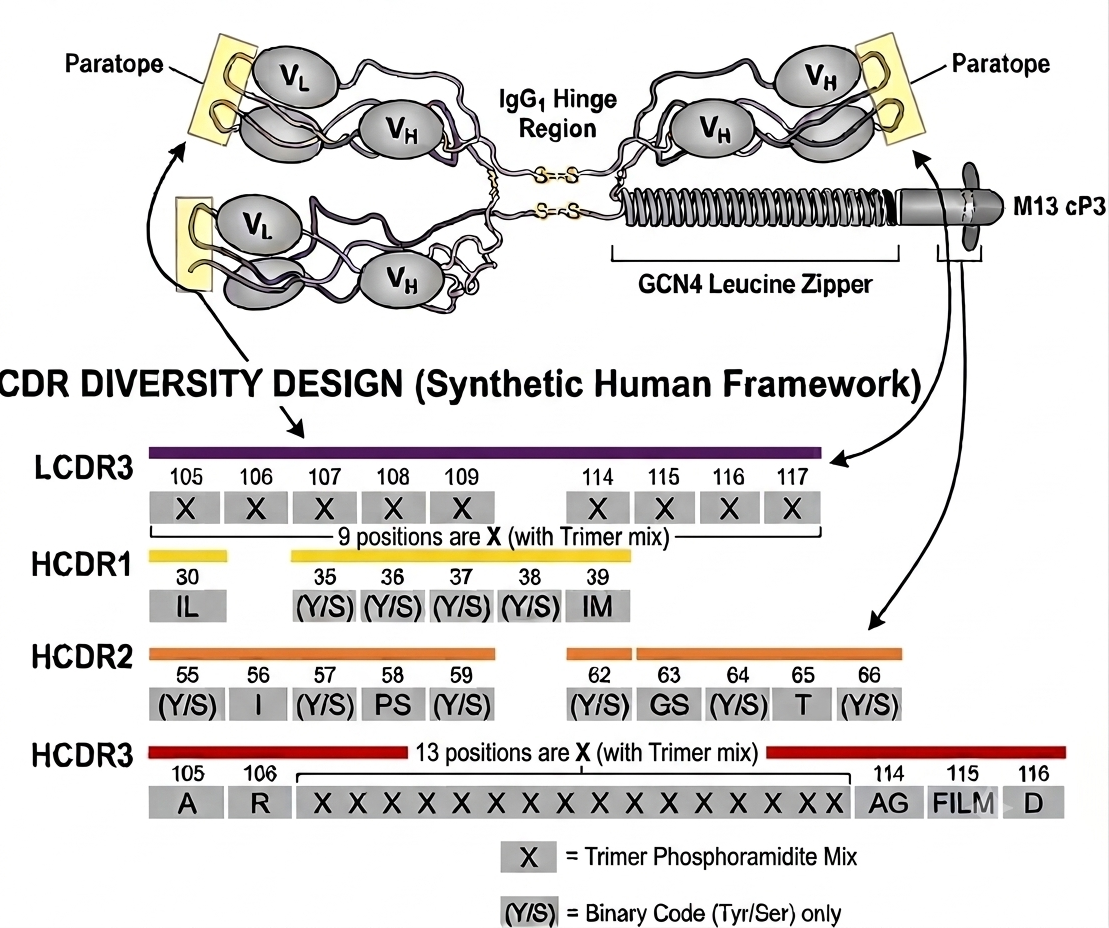
- Light-Chain Driven Reconstitution: Overcomes the rigid heavy-chain dominance seen in nature by leveraging a heavily diversified 9-amino acid position LCDR3. Given an equal genetic playing field, an engineered LCDR3 readily assumes a dominant role in driving high-affinity antigen recognition.
- Trimer Phosphoramidite Precision (HCDR3 & LCDR3): Utilizes controlled trimer codon mixtures within the 13-amino acid HCDR3 and 9-amino acid LCDR3 loops (25% Tyr, 20% Ser, 20% Gly, 10% Ala, and 5% each of Phe, Trp, His, Pro, Val). This enriches the central paratope with a residue profile optimized for specific, high-affinity protein interfaces.
- Minimalist Binary Design (HCDR1 & HCDR2): Solvent-accessible positions within HCDR1 and HCDR2 are restricted to a binary chemical diversity consisting entirely of tyrosine (Tyr) and serine (Ser). This provides clean, highly effective chemical interactions while maintaining excellent baseline loop stability.
- Structural Framework & Anchor Integrity: LCDR1 and LCDR2 are intentionally kept unmutated in their native parental sequence because structural data reveals they contribute minimally to the total buried surface area at the antigen interface. Combined with fixed structural anchor boundaries within HCDR3 (preserving native residues at positions 105, 106, 114, and 115), the library maintains outstanding baseline thermal and physical stability.
- Streamlined IgG Reformatting: Because selections are performed in a structured, bivalent Fab conformation, discovered leads transfer directly into therapeutic IgG formats without the affinity loss or oligomerization artifacts frequently caused by scFv reformatting.
Fusion BioLabs Humanized Bivalent Fab CDRs diversity map
Fusion BioLabs Humanized Bivalent Fab Expression Cassette map
Target Applications
The unique architectural combination of a high-diversity synthetic paratope and a controlled, IgG-like bivalent display format makes this library a powerful engine for demanding discovery campaigns. It is specifically optimized for applications where conventional monovalent Fab or unstable scFv libraries fail to capture or retain functional leads.
- High-Efficiency Cell-Surface Panning
Isolating therapeutic antibodies against native, multi-pass transmembrane proteins (such as GPCRs, ion channels, and heavily glycosylated tumor-associated antigens) directly on live cells is notoriously difficult.
- Overcoming Low Epitope Density: Target receptors are often expressed at low copy numbers on the cell surface. The bivalent display format exploits a controlled avidity effect, which significantly drops the effective off-rate of the phage during dense washing steps.
- Rescuing Moderate-Affinity Hits: Natural immune repertoires rely on heavy-chain dominance, which often misses valid structural epitopes. By utilizing a heavily diversified LCDR3 to drive antigen binding, this library rescues highly specific, moderate-affinity clones that are normally lost during stringent monovalent selections.
- Direct Selection of Internalizing Antibodies: For Antibody-Drug Conjugate (ADC) and payload delivery applications, the bivalent presentation of dual Fab arms effectively mimics natural IgG-mediated receptor engagement. This format triggers active, temperature-dependent receptor-mediated endocytosis, allowing for the direct enrichment of internalizing binders from cell lysates.
- Phenotypic Functional Agonist Screening
Conventional monovalent phage platforms can only select for binding affinity, meaning functional activation (agonism) must be engineered or screened downstream after reformatting into an IgG.
- Immediate Receptor Cross-Linking: Many cell-surface signaling receptors require dimerization or higher-order clustering to trigger downstream intracellular cascades. Because each phage particle displays two covalently linked, dimeric Fab arms via the engineered IgG1 hinge and leucine zipper, they can actively cross-link adjacent receptors directly during the panning stage.
- Streamlined Phenotypic Workflows: Discovered binders can be introduced directly into cell-based functional assays while still in the phage or soluble bivalent format. This completely bypasses the long, unpredictable reformatting steps that frequently result in a structural loss of function or altered binding kinetics when converting scFvs to IgGs.
- High-Affinity Panning Against Complex and Conserved Targets
- Conserved and Self-Antigens: Because the paratope is entirely synthetic and built on a stable human framework, it completely circumvents the immunological tolerance mechanisms of animal-derived hybridoma systems.
- Engineered Paratope Topography: Concentrating the trimer phosphoramidite diversity heavily into the elongated HCDR3 (13 positions) and LCDR3 (9 positions)—while maintaining strict framework anchor positions (105, 106, 114, 115)—creates flat, highly complementary binding topologies. This enables specific binding to shallow, hidden, or highly constrained protein interfaces.
Reference:
Lee CV, Sidhu SS, Fuh G. Bivalent antibody phage display mimics natural immunoglobulin. J Immunol Methods. 2004 Jan;284(1-2):119-32.
Persson H, Ye W, Wernimont A, Adams JJ, Koide A, Koide S, Lam R, Sidhu SS. CDR-H3 diversity is not required for antigen recognition by synthetic antibodies. J Mol Biol. 2013 Feb 22;425(4):803-11.