Product Overview
Fusion BioLabs offers antibody phage display library construction kits featuring specialized PCR primer sets and phagemid vectors for generating antibody libraries. These components support the construction of customized antibody phage display libraries for antibody discovery, screening, and affinity maturation research.
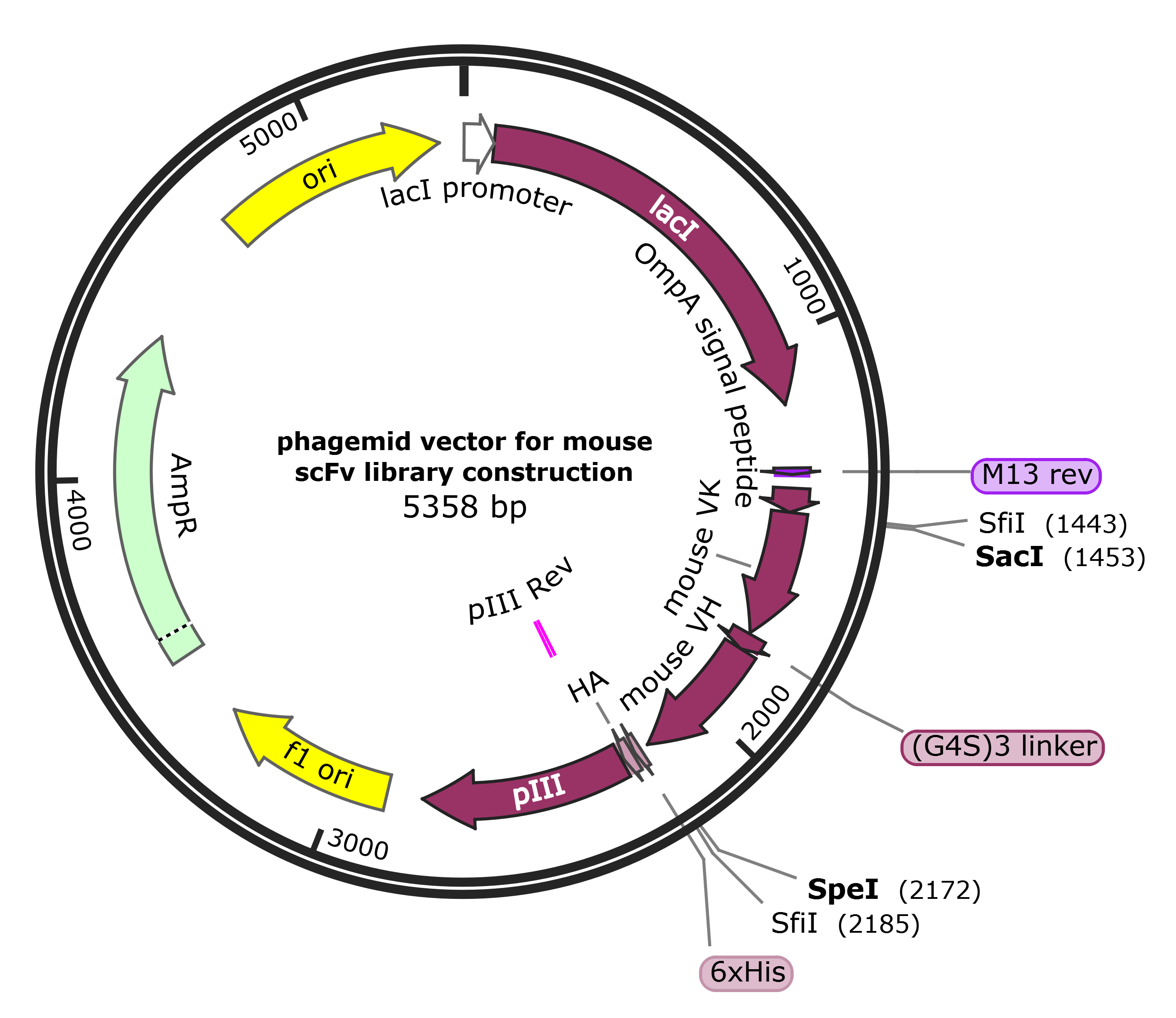
pAPD-m-scFv is a phagemid vector designed for constructing mouse single-chain variable fragment (scFv) antibody libraries. The general library construction workflow includes the following steps:
-
- Amplify mouse VH and VL repertoires from cDNA prepared from RNA isolated from mouse lymphoid tissues or other appropriate sources.
- Combine VH and VL repertoires using overlap-extension PCR to generate scFv constructs.
- Digest the pAPD-m-scFv vector and assembled scFv repertoires using either validated cloning method: Method A (SacI/SpeI) or Method B (SfiI). Both methods are described in the Version 3.0 Short Protocol.
- Ligate the digested and purified scFv fragments into the correspondingly digested and purified pAPD-m-scFv vector to construct mouse scFv phage display libraries. The supplied Short Protocol describes the SacI/SpeI cloning workflow.
Key Features
- Efficient scFv display: Designed to support expression and phage display of mouse scFv antibody fragments for screening and selection against target molecules.
- Flexibility and versatility: The pAPD-m-scFv vector supports both antibody phage display library construction and downstream antibody fragment expression, without requiring subcloning into a separate expression vector for compatible applications.
Specifications of Antibody Phage Display Vector
Specifications of Antibody Phage Display Vector| Antibiotic Resistance | Ampicillin (AmpR) |
| Constitutive or Inducible System | Inducible for downstream expression |
| Delivery Type | Transformation |
| Product Type | Phage display vector or Bacterial Expression vector |
| Cloning Method | Either [Both 5’end and 3’end SfiI sites] or [5’end SacI and 3’ end SpeI sites] |
Contents & Storage
Content of mouse scFv phage display library construction Kit| Primer Set 1 for amplification of mouse variable domain of heavy chain (VH) and light chain (Vk and Vλ) | ||
| Vial 1 | 100 µl, 10 µM | Primer mix (F+R) for VL repertoires amplification |
| Vial 2 | 100 µl, 10 µM | Primer mix (F+R) for VH repertoires amplification |
| Vial 3 | 100 µl, 10 µM | Assembly primers (F+R) for scFv repertoires construction |
| pAPD-m-scFv cloning vector for phage display mouse scFv library construction | ||
| Vial 4 | 10.0 µg in Tris-EDTA buffer | |
| Sequencing Primer set | ||
| Via 5 | 100 µl, 10 µM | Forward sequencing primer for mouse scFv insert (M13 Reverse) |
| Via 6 | 100 µl, 10 µM | Reverse sequencing primer for mouse scFv insert (pIII Reverse) |
- Storage: Store at -20°C. Primer sets and vectors are guaranteed stable for 12 months when properly stored.
Vector Usage
- Cloning mouse scFv inserts into the pAPD-m-scFv vector for antibody phage display library construction.
- Cloning selected mouse scFv candidates into the pAPD-m-scFv vector for downstream antibody fragment expression.