Product Overview Data Sheet Protocol
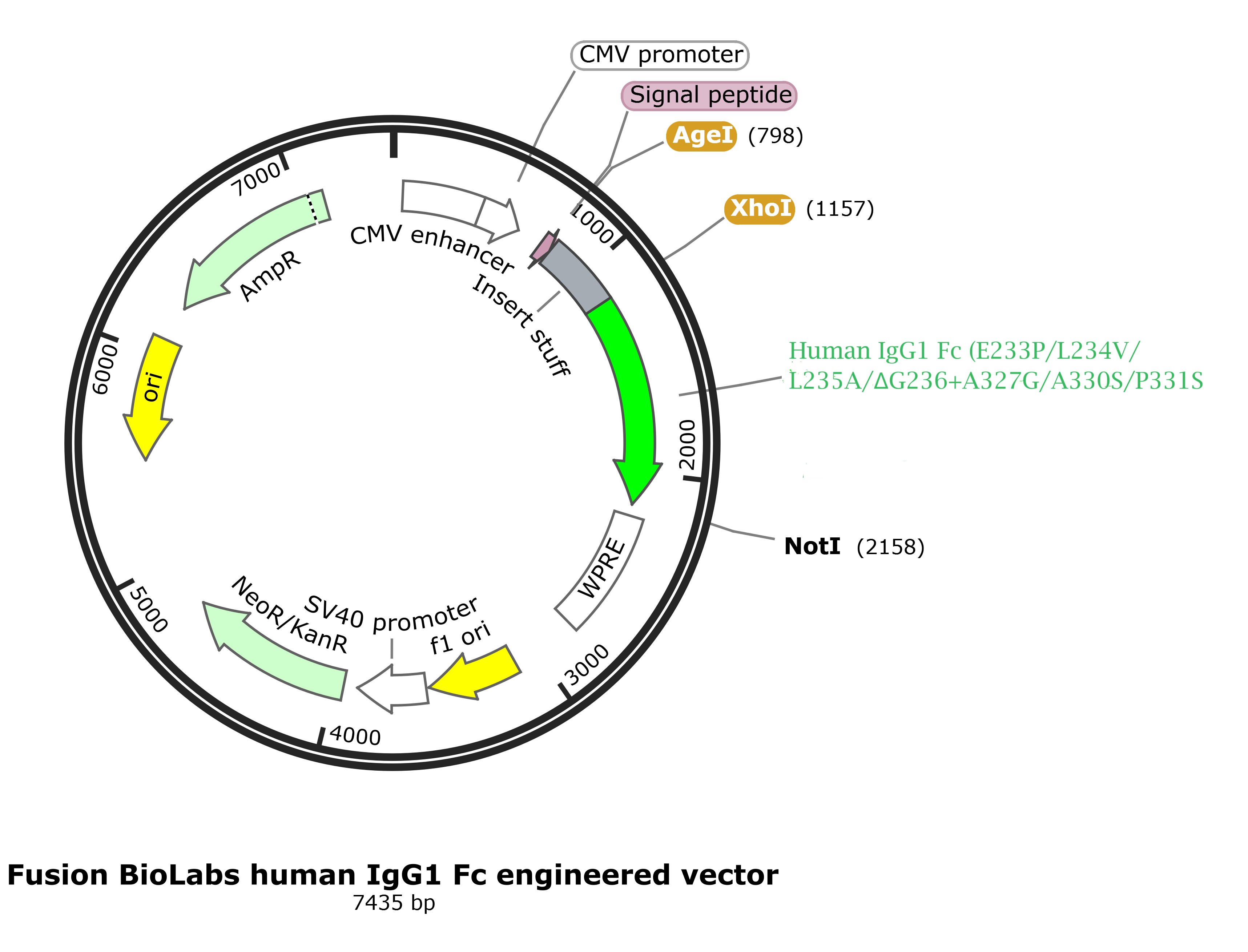
pFB-CHIg-hG1e4 is a cloning vector that expresses the human IgG1 heavy chain constant region with E233P/L234V/L235A/ΔG236 + A327G/A330S/P331S mutations. It is a constitutive mammalian expression vector designed to deliver exceptionally high levels of antibody expression. This circular vector features an enhanced, full-length CMV promoter and other expression elements that typically enable higher expression levels. It can be used in suspension-adapted cells, such as Expi293F™ and ExpiCHO™, for transient protein expression. Additionally, it can serve as a Geneticin®-selectable expression plasmid for engineering stable cell lines. The vector carries an ampicillin resistance gene.
Characteristics
Fc engineered human IgG1 expression with E233P/L234V/L235A/ΔG236 + A327G/A330S/P331S mutations:
– No binding to FcγRIIb and FcγRIIIa
– Reduced ADCC and CDC
| Antibiotic Resistance | Ampicillin (AmpR) |
| Constitutive or Inducible System | Constitutive |
| Delivery Type | Transfection |
| Promoter | CMV |
| Product Type | Mammalian Expression Vector |
| Cloning Method | Restriction Enzyme (5’-AgeI; 3’-XhoI) or Homologous Assembly |
Contents & Storage
- 5.0 µg of pFB-CHIg-hG1e4 in Tris-EDTA buffer
- Store at -20°. Vectors are guaranteed stable for 6 months when properly stored.
Materials required for Fc-engineered antibody generation
- pFB-CLIg-hk or pFB-CLIg-hl plasmid expressing the human kappa or lambda light chain.
Steps for Fc-engineered antibody generation
- Clone your heavy chain variable region (VH) into the pFB-CHIg-hG1e4 vector to make a heavy chain expression plasmid.
- Clone your light chain variable region (VL) into the pFB-CLIg-hk or pFB-CLIg-hl vector to make a light chain expression plasmid.
- Co-transfect both heavy chain and light chain expression plasmids into your desired mammalian cell (such as CHO or HEK293) for Fc-engineered antibody production.
References
- Moore GL et al., 2019. A robust heterodimeric Fc platform engineered for efficient development of bispecific antibodies of multiple formats. Methods 154: 38-50.